
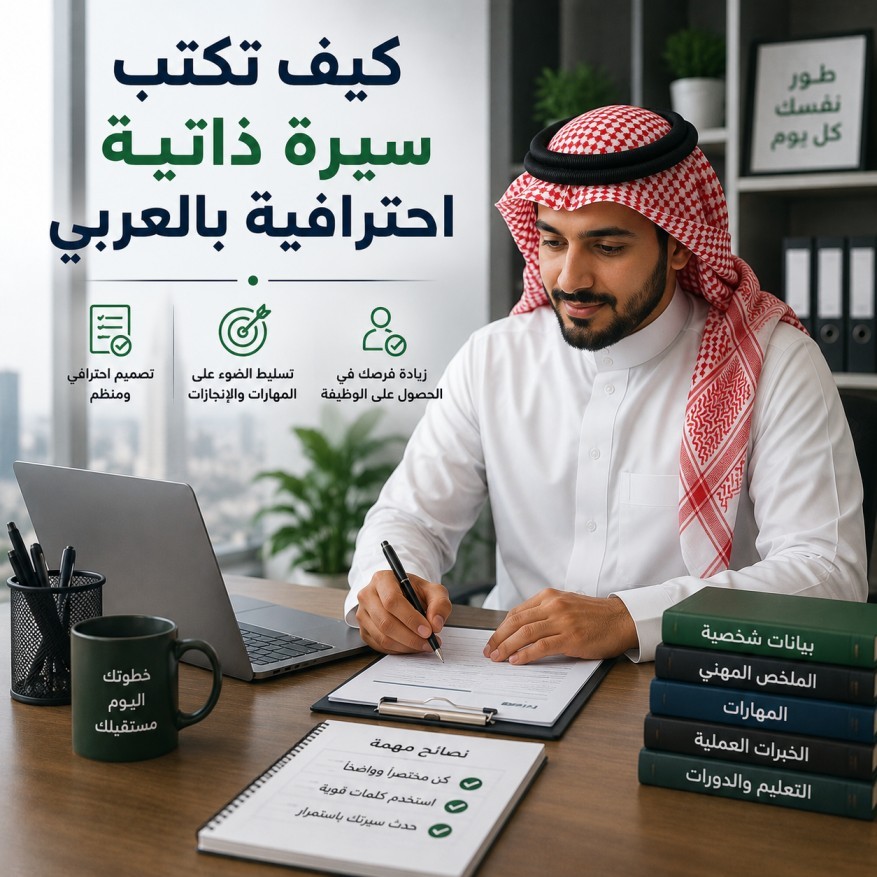
How to Write a Professional CV in Arabic 2026?
Many people think that creating a CV is simply about writing personal information and work experience. However, the truth is that writing a professional CV requires clear organization, a smart presentation of skills, and wording that attracts the recruiter’s attention within a few seconds.
In this guide, you will learn step by step how to create a professional CV, the most important sections it should include, and a ready-to-use sample you can apply directly.
What Is a CV and Why Is It Important?
A CV is a document that summarizes your experience, education, skills, and professional achievements in one or two pages. Its main purpose is to introduce you quickly to the employer and convince them that you are suitable for the role.
The importance of a strong CV lies in the fact that it:
- Presents your skills and experience in an organized way.
- Shows your professionalism and seriousness when applying.
- Makes it easier for recruiters to evaluate you quickly.
- Increases your chances of getting a job interview.
- Helps you highlight your strengths compared to other candidates.
In the Saudi and Egyptian job markets, competition has become very strong. Therefore, creating a professional CV gives you a clear advantage, especially if it is well organized and tailored to the job you are applying for.
Elements of a Professional CV
For your CV to be effective, it should include essential sections that help the recruiter quickly understand your experience and skills.
1. Personal Information
Basic personal information includes:
- Full name.
- Phone number.
- Email address.
- City.
- LinkedIn profile link, if available.
Avoid adding unnecessary information such as marital status or national ID number unless it is directly required by the employer.
2. Professional Summary
The professional summary is a short paragraph that explains who you are, what you offer, and what type of opportunity you are looking for. It is best to keep it between 3 and 4 lines only.
Example:
A Business Administration graduate with strong organizational and communication skills, seeking to develop my career in human resources within a professional work environment.
3. Work Experience
List previous jobs from the most recent to the oldest, including the company name, job title, employment period, and key achievements. Try to focus on results rather than simply listing tasks.
4. Educational Qualifications
This section should include the name of the university or institute, your specialization, and graduation year. If you are a fresh graduate, you may place your education section before work experience.
5. Skills
The skills section is one of the most important parts of a CV because it shows what you can offer to the employer. It can include both soft and technical skills, such as:
- Communication.
- Teamwork.
- Time management.
- Problem-solving.
- Excel.
- Data analysis.
- Content writing.
You can also enroll in the Skills Required for the Job Market course to identify the most suitable skills for your field.
6. Courses and Certifications
Training courses and professional certifications strengthen your CV, especially for beginners or fresh graduates who do not yet have much work experience.
Steps to Write a CV Step by Step
If you are wondering how to create a CV correctly, start with these practical steps:
Step One: Define Your Career Goal
Before creating a CV, ask yourself: What job am I targeting? Defining your goal helps you choose the right information and highlight the skills related to the position.
Step Two: Choose a Clear Format
Keep the design simple, organized, and easy to read. Avoid using too many colors or unnecessary elements because the main goal is to present your information clearly.
Step Three: Focus on Achievements, Not Tasks
Instead of writing, “I worked in customer service,” you can write, “Contributed to increasing customer satisfaction by 20%.” Numbers and results make your CV more convincing.
Step Four: Customize Your CV for Each Job
Do not use the same CV for every job. Adjust the skills, experience, and professional summary according to each job’s requirements, because customization increases your chances of acceptance.
Step Five: Review It Before Sending
Before sending your CV, make sure it is free from spelling mistakes, the information is clear, contact details are correct, and the format is easy to read on both mobile and desktop.
Arabic CV Sample
You can use this simple sample as a starting point when creating a professional CV:
Name: Layla Mohammed
Phone Number: 05XXXXXXXX
Email: example@email.com
City: Riyadh
Professional Summary
A Marketing graduate with strong communication and campaign management skills, seeking to develop my experience in a professional environment.
Experience
Marketing Officer — XYZ Company
2023 – 2025
- Managed advertising campaigns.
- Improved engagement by 30%.
Education
Bachelor’s Degree in Marketing — King Saud University
Skills
- Time management.
- Communication.
- Digital marketing.
- Excel.
- Content writing.
Courses
- Digital Marketing Course.
- Project Management Course.
Free Tools to Create a CV
If you want to create a CV easily, you can use free tools that help with design and organization, including:
- Canva: Provides ready-made templates and professional designs that can be customized.
- LinkedIn Resume Builder: Helps you turn your LinkedIn profile into a CV.
- Microsoft Word Templates: A simple and quick option for creating a clear CV template.
- Google Docs: Free, easy to edit, and simple to share.
The tool you choose depends on your needs, but the quality of the content is always more important than the design alone.
Common Mistakes to Avoid in Your CV
Some of the most common mistakes that reduce the chances of your CV being accepted include:
- Writing too much unnecessary information.
- Using an unprofessional email address.
- Having spelling or language mistakes.
- Including experience that is not related to the job.
- Using a complicated or crowded design.
- Exaggerating or writing incorrect information.
- Sending the same CV to every job without customization.
Remember that a good CV should be concise, clear, honest, and tailored to the job you are applying for.
How to Write a CV Without Experience
If you are a fresh graduate or do not have work experience yet, do not worry. You can build a strong CV by focusing on the elements that prove your readiness to learn and work.
You can focus on:
- University projects.
- Cooperative training or internships.
- Training courses.
- Soft and technical skills.
- Volunteer work.
- Student activities.
Developing your skills through specialized programs such as the Human Resources Diploma from IGTS can also improve your chances in the job market and add clear value to your CV.
Tips to Make Your CV More Professional
Use Keywords Relevant to the Job
Many companies now use electronic systems to scan CVs before they reach the recruiter. Therefore, when creating a CV, it is important to include keywords related to the field you are targeting. If you are applying for a marketing role, use words such as “digital marketing” and “campaign management.”
Choose a Simple and Clear Design
Choosing the right design is just as important as the content itself. It is always better for the design to be simple and professional, using calm colors and clear fonts. Avoid crowded templates or excessive decoration.
Arrange Experience from Newest to Oldest
When writing your work experience, start with your most recent role and move backward, because employers usually care most about your latest professional experience. If you have achievements related to the job, try to highlight them with numbers and results.
Update Your CV Regularly
Do not use the same CV for years without updating it. Review it whenever you gain new experience, earn an additional certificate, or develop a new skill, so it is ready for any sudden opportunity.
Connect Skills to Practical Examples
Soft skills such as communication, leadership, problem-solving, and time management are very important. However, it is better not to only list them; try to connect them to situations or achievements that prove you actually have them.
Does the CV Differ Depending on the Type of Job?
Yes, it is better to customize your CV for each job you apply for. For example, if you are applying for a marketing role, focus on marketing skills, campaigns, and data analysis. If the role is in human resources, it is better to highlight communication skills, employee management, and recruitment.
Customizing your CV increases your chances of acceptance because it makes it more relevant to the job’s needs and shows the employer that you read and understood the job description.
Why Is Continuous Learning a Strong Addition to Your CV?
In today’s job market, continuous learning has become a real competitive advantage. When an employer sees that you invest your time in developing yourself through courses and certificates, this reflects your desire for professional growth.
Therefore, adding recent courses and new skills to your CV gives you a better image and increases your chances of standing out among other candidates.
Frequently Asked Questions About CVs
What Are the Most Important Elements of a CV?
The most important elements of a CV are personal information, professional summary, work experience, education, skills, and courses or certifications.
How Many Pages Should a CV Be?
A CV is usually one page for beginners and fresh graduates, and two pages for experienced professionals. The most important thing is that it remains concise and clear without unnecessary details.
What Is the Difference Between an Arabic CV and an English CV?
The main difference is the language, and sometimes the order of some information depending on the market or employer. For some jobs in Saudi Arabia or Egypt, an Arabic CV may be required, while international roles or multinational companies may prefer an English version.
How Do I Write a CV Without Experience?
Focus on education, university projects, training, courses, skills, and volunteer activities. The goal is to show your readiness to learn and your ability to grow.
Can I Create a CV as a Free PDF?
Yes, you can create a free CV PDF using tools such as Canva, LinkedIn Resume Builder, Microsoft Word, and Google Docs.
Develop Your Career Opportunities Now
Writing a strong CV is not just a step for applying to a job; it is an investment in your professional future. The more organized, clear, and properly targeted your CV is, the greater your chances of reaching job interviews.
Start by improving your CV, and continue developing your professional skills through training programs that help you compete confidently in the job market.
Start Now
Develop your professional skills and enroll in the IGTS accredited diploma now to build a stronger career path.
Updated at: 2026-10-10 17:34:37