
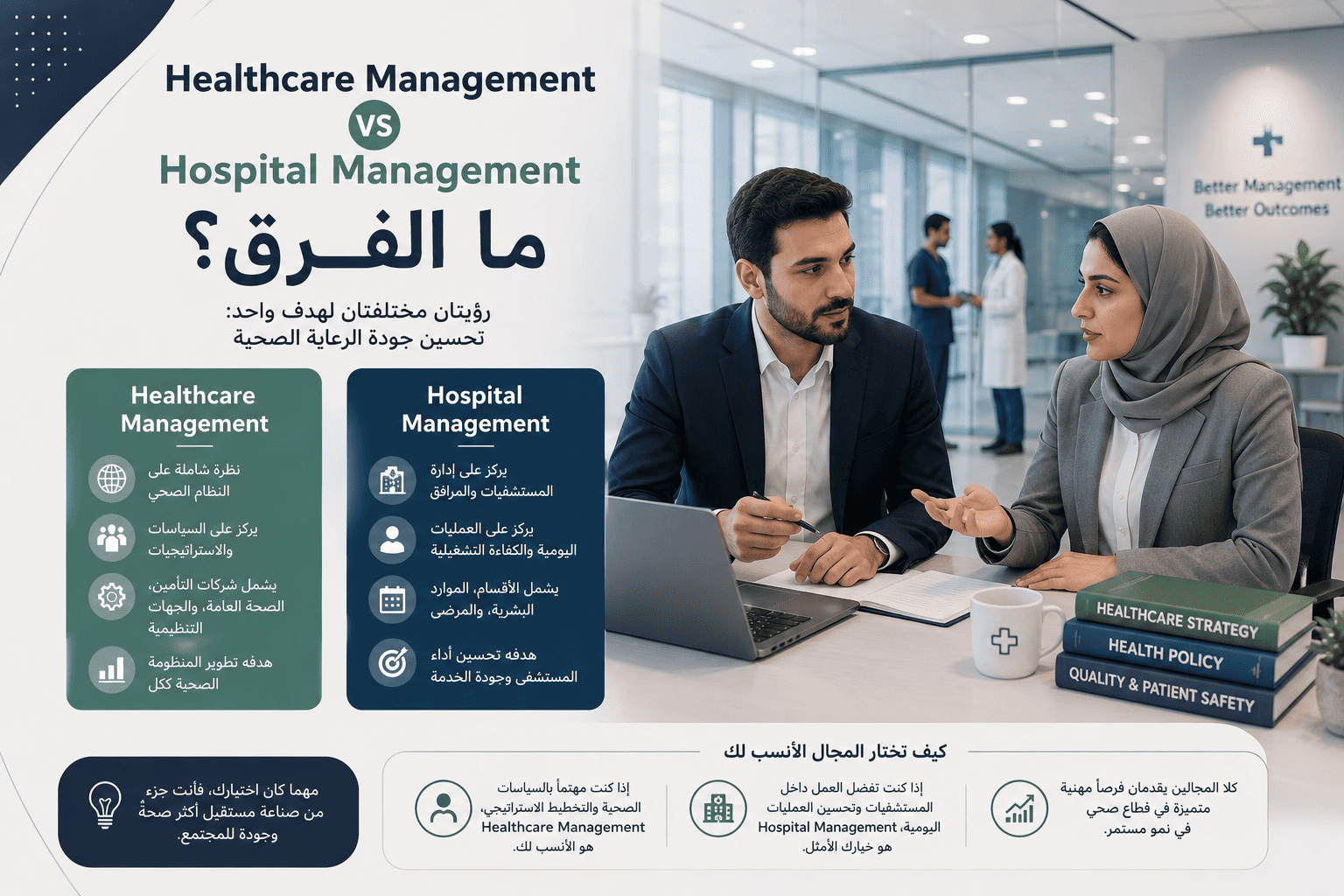
Healthcare Management vs. Hospital Management: What Is the Difference?
If you work in the healthcare sector and are considering moving into management, you will probably come across two common terms: Healthcare Management and Hospital Management.
At first, the difference between them may seem small because both are related to managing healthcare services. However, the scope of each field is different.
Healthcare Management refers to the broader management of healthcare services and organizations, while Hospital Management focuses more specifically on operating and managing hospitals as healthcare institutions.
One path may therefore be more suitable for you than the other depending on the type of organization you want to work in, the role you are targeting, and whether you prefer a broad management career within healthcare or a stronger focus on the hospital environment.
Understanding this difference is particularly important before choosing a Hospital Management Diploma or a Master’s in Hospital Management, because the name of a program alone does not always tell you what skills and knowledge you will actually gain.
Healthcare Management or Hospital Management?
Healthcare Management is the broader field concerned with planning, organizing, and managing different types of healthcare services.
Hospital Management, on the other hand, focuses more specifically on managing hospitals, their departments, resources, and daily operations.
Hospital Management can therefore be viewed as a more specialized area within the wider field of Healthcare Management, although there is considerable overlap between the skills and subjects covered by both.
The main difference is not that one field is managerial and the other is healthcare-related.
The real difference lies in the scope of management and the environment in which management principles are applied.
Where Does the Difference Between the Two Fields Begin?
Imagine working within a large healthcare organization that includes hospitals, clinics, primary care centers, and several other healthcare services.
Someone working in Healthcare Management may deal with broader issues such as:
- Healthcare service planning
- Resource management
- Quality management
- Performance monitoring
- Operational policies
- Coordination between different healthcare facilities and services
A professional specializing in Hospital Management, however, may focus more closely on the hospital itself.
Responsibilities may include:
- Managing hospital operations
- Coordinating departments
- Managing human resources
- Budget management
- Patient experience
- Workflow management
- Operational processes within the hospital
Choosing one pathway does not mean that the other is completely unrelated.
There is significant overlap between them, but the main difference becomes clearer when looking at the scope of responsibility and the type of management environment.
Quick Comparison: Healthcare Management vs. Hospital Management
| Comparison Point | Healthcare Management | Hospital Management |
|---|---|---|
| Scope | Broader | More specialized |
| Environment | Different healthcare organizations, services, and sectors | Primarily hospitals |
| Main focus | Managing healthcare services, resources, and performance | Managing and operating hospitals |
| Nature of roles | Administrative, strategic, planning, and operational | Administrative and operational roles within hospitals |
| Suitable for | Professionals who want a broader management career within healthcare | Professionals who specifically want to work in hospital administration |
However, this comparison does not mean that every educational program using one of these titles will follow these boundaries exactly.
Program structures vary between educational institutions, so you should always review the actual curriculum before enrolling.
What Does Healthcare Management Include?
When we talk about Healthcare Management, we are referring to the management of healthcare systems and services that must balance service quality, operational efficiency, available resources, and patient needs.
A Healthcare Management program may therefore include topics such as:
- Healthcare management and planning
- Human resources management
- Financial management in healthcare organizations
- Quality management
- Process improvement
- Risk management
- Performance evaluation
- Healthcare services management
- Leadership and decision-making
The exact subjects will vary depending on the academic program.
One of the main advantages of Healthcare Management is its broader perspective.
Instead of focusing only on hospitals, students learn how healthcare services, resources, and operations can be managed across a wider healthcare environment.
This may be particularly suitable if you do not want to limit your career to one specific type of healthcare institution.
What Does Hospital Management Mean in Practice?
Hospital Management focuses on managing an institution that combines a large number of services, departments, and professional specialties in one environment.
A hospital is not simply a place where treatment is provided.
It is a complex organization that includes:
- Medical teams
- Nursing teams
- Administrative staff
- Operational processes
- Human resources
- Financial resources
- Information systems
- Supply chains
- Quality requirements
- Patient safety requirements
This complexity is what makes effective hospital management essential.
A hospital administrator or manager cannot make decisions independently from other departments.
A change in resources, schedules, staffing, or operational procedures may affect several departments, patient experience, and overall efficiency.
For this reason, a Hospital Management Diploma or a Master’s in Hospital Management may include subjects related to administration, operations, resources, quality, and hospital processes.
Read Also
Which Field Offers a Broader Range of Applications?
When comparing the two fields, Healthcare Management generally offers a broader range of environments in which management skills can be applied.
Healthcare Management may be relevant to:
- Hospitals
- Clinics and healthcare centers
- Healthcare organizations
- Organizations responsible for managing healthcare services
- Institutions providing services related to the healthcare sector
Hospital Management is more directly connected to hospitals and their operation.
However, a broader field is not automatically a better career choice.
If you already know that you want to build your career within hospitals, a more focused specialization may be useful.
If you prefer to keep your career options open across different healthcare settings, Healthcare Management may be more aligned with your goals.
What Do Students Study in Hospital Management Programs?
There is no single curriculum followed by every Hospital Management program.
When comparing different options, look for subjects that help you understand the actual administrative environment of a hospital.
Common areas may include:
Healthcare Administration and Planning
This area helps you understand how healthcare services and resources are planned and how operational goals can be connected to the needs of the organization.
Quality Management
Quality is a fundamental part of healthcare organizations, which is why quality management appears in many Healthcare Management and Hospital Management programs.
Human Resources Management
Hospitals depend on multidisciplinary teams.
Hospital administrators therefore need to understand workforce planning, team management, employee performance, and staffing needs.
Financial Management
Financial management helps you understand the relationship between available financial resources and operational decisions within healthcare organizations.
Operations Management
Operations management focuses on organizing workflows and managing the movement of services, information, and resources between departments.
Leadership and Decision-Making
Healthcare management is not based on theoretical knowledge alone.
Daily decisions require managers to analyze information, work with multidisciplinary teams, and balance competing priorities.
When reviewing a program, do not focus only on how many subjects are included.
Instead, ask how closely those subjects relate to the type of work you want to do in the future.
Is Healthcare Management Suitable for Healthcare Professionals?
Healthcare Management can be particularly relevant for professionals who want to move from technical or clinical roles into management.
Someone with experience in healthcare already understands the environment in which healthcare services are delivered.
However, moving into administration requires a different set of skills.
You may need to develop skills in:
- Team management
- Performance analysis
- Planning
- Resource management
- Understanding operations
- Solving administrative problems
- Decision-making
- Quality and risk management
This is where specialized management education can add value.
It does not replace your healthcare experience. Instead, it adds a management perspective that can help you understand and work with the organization in a different way.
When Is Hospital Management a More Suitable Choice?
If your career goal is clear from the beginning and you specifically want to work in hospital administration, a program focused on the hospital environment may be more suitable.
Instead of studying healthcare administration from a broad perspective, you may focus more closely on the challenges involved in managing a hospital.
This may be useful for healthcare professionals who plan to move into administrative positions within hospitals or for those who want a deeper understanding of how hospitals operate.
However, do not allow the program title alone to determine your decision.
You may find a Healthcare Management program with strong hospital administration content, while a Hospital Management program may include broader healthcare administration subjects.
The curriculum is what reveals the real difference.
How Do You Choose Between a Hospital Management Diploma and a Master’s in Hospital Management?
Another factor to consider is the level of qualification.
If you are comparing a Hospital Management Diploma with a Master’s in Hospital Management, do not focus only on the qualification name.
Begin by identifying your goal.
If you want to develop practical healthcare management knowledge or add administrative skills to your existing professional experience, a diploma may be one option worth considering.
If you are looking specifically for a postgraduate academic degree in the field, a master’s program may be more closely aligned with your objective.
When comparing the two options, consider:
- Academic level of the program
- Program duration
- Curriculum and subjects
- Admission requirements
- Study format
- Awarding institution
- How closely the program aligns with your career objective
There is no rule stating that a master’s degree is suitable for everyone or that a diploma is always the faster or more practical choice.
The right decision depends on your current situation and what you want to achieve after completing the program.
What Jobs Are Related to Healthcare and Hospital Management?
Job titles vary depending on the organization, professional experience, and qualifications.
However, studying Healthcare Management may be related to several administrative and operational career paths within the healthcare sector.
Examples include:
- Healthcare facility administration and operations
- Healthcare services coordination
- Operations management
- Quality management
- Human resources management in healthcare organizations
- Healthcare planning
- Management of administrative departments and units
- Monitoring and evaluation
Actual job titles and requirements differ between organizations and positions.
This is important when planning your career.
It is not enough to say:
“I want to work in healthcare management.”
Try to identify the type of role you actually want.
Are you interested in operations management?
Do you want to work in quality management?
Are you interested in human resources?
Do you specifically want an administrative role within a hospital?
Each answer may lead you toward different skills, education, and training requirements.
How Can Specialization Help You Build a Career in Healthcare?
Working in healthcare does not mean that your career must remain clinical.
There is a significant administrative and operational structure behind every healthcare service.
This side of healthcare requires professionals who understand the sector while also having management skills.
For professionals planning to move into administration, combining healthcare experience with management knowledge can therefore be valuable.
The goal is not to become a management professional who is disconnected from the healthcare environment.
It is also not enough to rely exclusively on healthcare experience without developing administrative skills.
The objective is to build a combination of skills that helps you understand:
- The organization
- Healthcare services
- Operations
- Resources
- Management decisions
How Do You Choose a Healthcare Management Program in Saudi Arabia?
If you are looking for a program in Saudi Arabia, begin by identifying the pathway that matches your career objective and then compare available programs using clear criteria.
You can use the following checklist:
- Identify the type of position you want to pursue.
- Decide whether you want broader Healthcare Management or more specialized Hospital Management.
- Review the curriculum subject by subject.
- Check the admission requirements.
- Review the study format and whether it fits your work schedule.
- Verify the educational institution and the relevant accreditation or recognition of the qualification.
- Compare the program duration, cost, and requirements.
- Ask about any unclear details before enrolling.
Following this process can help you avoid choosing a program simply because its title contains the word “Healthcare” or “Hospital.”
Frequently Asked Questions
What Is the Difference Between Healthcare Management and Hospital Management?
Healthcare Management has a broader scope because it involves managing healthcare services and organizations in general.
Hospital Management focuses more specifically on managing and operating hospitals.
However, the two fields share many subjects and management skills, and the exact boundaries may differ between educational programs.
Is Hospital Management Part of Healthcare Management?
Hospital Management can generally be considered a specialized area within the broader field of Healthcare Management.
However, educational institutions may use these terms differently.
For this reason, it is better to review the actual program content rather than relying only on theoretical definitions.
Is a Hospital Management Diploma Suitable for Healthcare Professionals?
It may be suitable for healthcare professionals who want to add management skills to their existing healthcare experience.
However, whether the diploma is suitable depends on the individual's career objectives, the program requirements, and its curriculum.
If your goal is to move into administration, review the subjects carefully and make sure they develop the skills you need.
Should I Choose a Master’s in Hospital Management or Healthcare Management?
If you specifically want to work in hospital administration, a program focused on Hospital Management may be more suitable.
If you prefer a broader career within the healthcare sector, Healthcare Management may be more closely aligned with your goals.
In either case, compare the actual curriculum before making your final decision.
Can Healthcare Professionals Move into Healthcare Management?
Healthcare professionals can consider moving into administrative roles by developing skills in:
- Management
- Leadership
- Planning
- Operations
- Resource management
- Decision-making
The requirements for making this transition vary according to the organization and position.
It is therefore useful to identify your target role first and then determine which qualifications and skills are required.
Which Path Is Right for You?
Choosing between Healthcare Management and Hospital Management is not simply about memorizing two different definitions.
The more important question is where you want your career to take you.
If you want to understand healthcare management from a broad perspective, Healthcare Management may provide a suitable foundation.
If your career objective is specifically related to managing and operating hospitals, Hospital Management may be more closely aligned with your goals.
In either case, do not make the degree title your only deciding factor.
Review the curriculum, the skills you will develop, the study format, the educational institution, and how closely the program supports your intended career path.
If you are interested in specialized study in this field, you can explore the Hospital Management Diploma/Master section to learn more about available Hospital Management options and compare them with your professional goals.
Start with the Path That Matches Your Goals
IGTS offers programs in Hospital Management for professionals who want to develop their understanding of management within the healthcare sector, whether their goal is to add management skills to their existing experience or build a professional career in healthcare facility administration.
If you are unsure which program is most suitable for you, you can contact the IGTS team to review the available options and compare them based on your career goals.
Start Now
Choose the healthcare management path that matches your career goal, and review the actual curriculum before enrolling.
Updated at: 2026-10-10 14:34:48