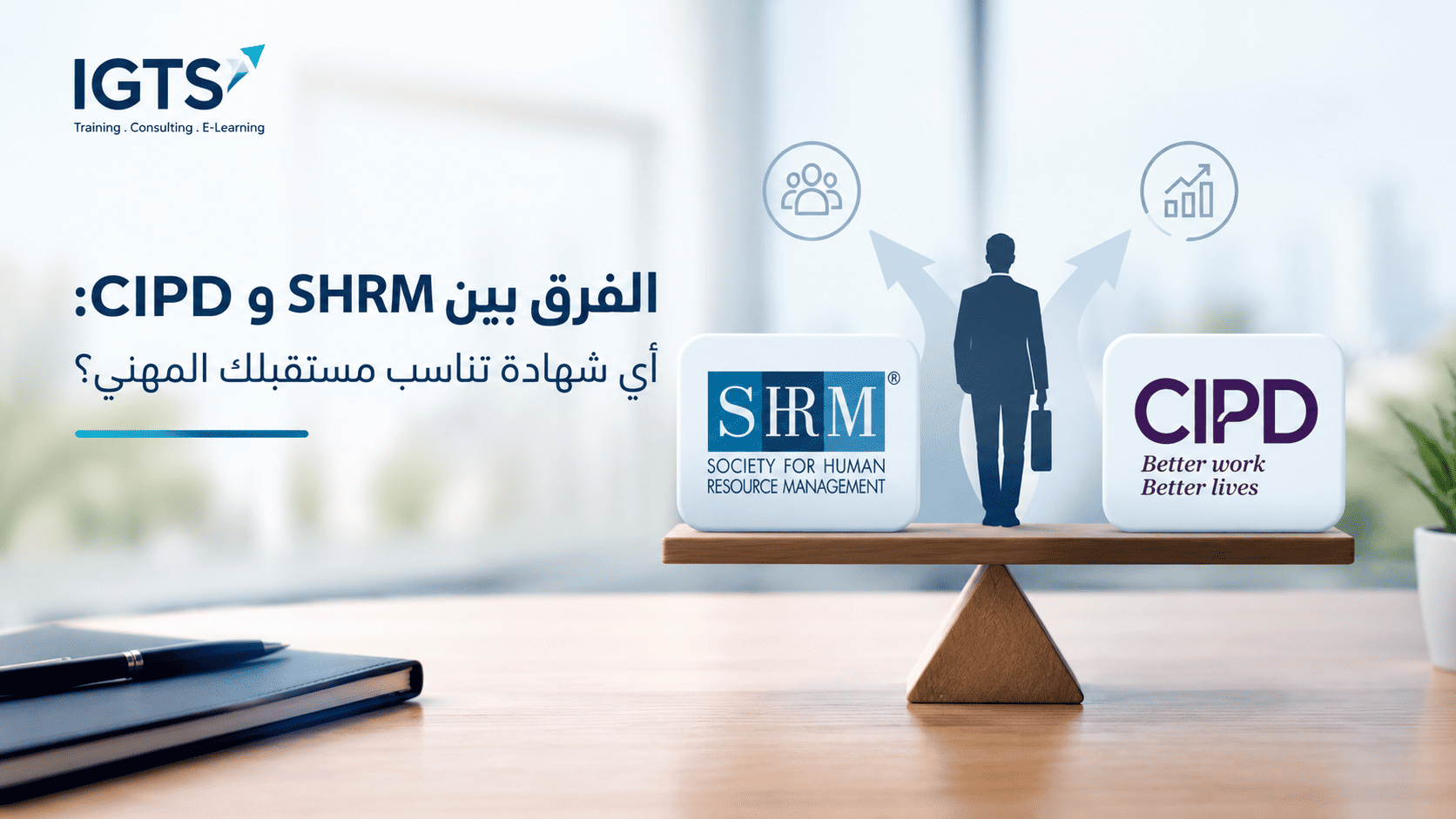
SHRM vs CIPD: Which Certification Suits Your Professional Future?
If you work in human resources or are planning to enter the profession, you may be comparing SHRM and CIPD and wondering which path is worth your time and investment. Both are well-known professional routes in HR, but they do not offer the same type of credential or follow the same study and assessment model.
SHRM offers professional certifications focused on the knowledge and competencies required for operational and strategic HR practice, while CIPD offers structured qualifications designed for different career stages and linked to professional membership levels.
This guide compares SHRM and CIPD in terms of eligibility, content, assessment, costs, and career stage, helping you decide which route may be more suitable for your HR goals in Saudi Arabia, Egypt, or other markets.
What Are SHRM Certifications and CIPD Qualifications?
The main difference between SHRM and CIPD lies in the type of credential and the way competence is assessed. SHRM offers two principal professional certifications, SHRM-CP and SHRM-SCP, which are earned by meeting the eligibility requirements and passing an examination. CIPD offers structured qualifications at Foundation, Associate, and Advanced levels.
The two systems should therefore not be treated as directly equivalent levels. The right choice depends on your experience, career goals, preferred learning style, and the requirements of the roles you are targeting.
What Is SHRM Certification?
SHRM stands for the Society for Human Resource Management. It offers professional certifications designed to assess the knowledge, competencies, and behaviors required in HR practice.
- SHRM-CP – Certified Professional: Designed for professionals involved in operational HR work such as implementing policies, supporting day-to-day HR functions, and serving employees and stakeholders. It is also available to people pursuing a career in HR.
- SHRM-SCP – Senior Certified Professional: Designed for professionals performing strategic HR responsibilities such as developing policies, overseeing integrated HR operations, leading initiatives, and aligning HR strategy with organizational goals.
SHRM-CP applicants do not need a university degree or previous HR experience, although basic knowledge of HR practices is recommended.
SHRM-SCP requires at least three years of strategic-level HR or HR-related work, or three years as a SHRM-CP credential holder while working in or transitioning toward a strategic role. Qualifying strategic experience is also subject to SHRM's work-hour requirements.
What Are CIPD Qualifications?
CIPD stands for the Chartered Institute of Personnel and Development, a professional body focused on people management, learning and development, and organizational development.
Unlike SHRM's certification-exam route, CIPD qualifications are taught through approved study centres. CIPD defines the qualifications, learning outcomes, and assessment standards and awards the final qualification.
- Foundation Certificate – Level 3: Designed for beginners and people in support roles who want to establish a foundation in the people profession.
- Associate Diploma – Level 5: Suitable for HR or L&D professionals who want to develop their skills and take on broader responsibilities.
- Advanced Diploma – Level 7: Intended for experienced professionals who want to deepen their strategic and leadership knowledge.
Completing the Foundation Certificate leads to Foundation Membership. Completing an Associate or Advanced Diploma leads to Associate Membership, while Advanced Diploma holders may later be eligible to upgrade to Chartered Member or Chartered Fellow depending on their experience and assessment route.
SHRM vs CIPD: Eligibility, Assessment and Costs
1. Eligibility Requirements
SHRM-CP does not require a university degree or previous HR experience, making it accessible to people entering the profession as well as operational HR professionals. SHRM-SCP is intended for professionals with qualifying strategic HR experience.
CIPD qualifications progress by level. The Foundation Certificate is designed for beginners, the Associate Diploma supports professionals building deeper operational expertise, and the Advanced Diploma focuses more heavily on strategic and leadership practice.
| Comparison | SHRM | CIPD |
|---|---|---|
| Credential Type | Professional certifications | Structured professional qualifications |
| Main Levels | SHRM-CP and SHRM-SCP | Level 3, Level 5 and Level 7 |
| Assessment Route | Professional examination | Study units and assessments |
| Professional Outcome | SHRM-CP or SHRM-SCP credential | CIPD qualification plus associated membership route |
2. Content and Assessment
SHRM certification is based on the SHRM Body of Applied Skills and Knowledge, or SHRM BASK, which covers the knowledge and behavioral competencies required for HR practice.
Candidates complete the application process and then take the examination at an authorized Prometric testing centre. SHRM examinations are also available in Arabic for eligible residents of countries including Saudi Arabia and Egypt.
CIPD qualifications follow a unit-based learning and assessment model. Approved study centres deliver the learning and initially mark assessments, while CIPD defines the assessment standards and moderates results.
The difference is therefore not simply “theoretical versus practical.” SHRM primarily demonstrates competence through a standardized professional examination, whereas CIPD demonstrates learning through structured study and unit assessments.
3. Costs
For the 2026 SHRM testing year, standard SHRM-CP and SHRM-SCP exam fees are:
- $399 for SHRM members.
- $499 for nonmembers.
The 2026 early-bird fees are $350 for members and $450 for nonmembers. These figures relate to the examination application and do not necessarily include preparation courses or study resources.
CIPD qualification fees vary by study centre. CIPD's indicative UK ranges are:
| Qualification | Indicative UK Cost |
|---|---|
| Foundation Certificate | £1,300–£2,300 |
| Associate Diploma | £1,600–£3,600 |
| Advanced Diploma | £3,000–£7,000 |
These are indicative ranges rather than universal prices. Membership and other costs may also apply, so compare the full cost of each route rather than tuition or examination fees alone.
Which Route Is Better for Working in Saudi Arabia?
There is no single certification that is automatically best for everyone targeting the Saudi HR market. Your choice should reflect the roles you want, your current level of experience, your preferred learning method, and employer requirements.
Consider SHRM If You Want To:
- Demonstrate HR competence through a professional certification examination.
- Enter the profession or validate operational HR knowledge through SHRM-CP.
- Progress toward strategic responsibilities and meet the SHRM-SCP eligibility requirements.
- Prepare against a defined professional knowledge and competency framework.
Consider CIPD If You Want To:
- Develop knowledge progressively through a structured qualification.
- Study HR or L&D topics through units and assignments.
- Build expertise in people management or learning and development.
- Progress through a qualification route connected to professional membership.
What About Saudi Employer Requirements?
Review actual vacancies for the positions you are targeting, such as HR Specialist, HR Business Partner, or HR Manager. Check whether employers specifically request SHRM or CIPD, list either as preferred, or place more emphasis on experience and role-specific skills.
Neither credential guarantees employment or promotion. Professional qualifications can strengthen your profile, but hiring decisions also depend on experience, skills, knowledge of relevant employment practices, and your ability to apply HR concepts in real situations.
Which One Fits Your Career Stage?
| Career Stage | Options to Consider |
|---|---|
| Graduate or entering HR | SHRM-CP or CIPD Foundation depending on your learning preference and goal |
| Operational HR experience | SHRM-CP or CIPD Associate depending on your role and development needs |
| Strategic or leadership responsibilities | SHRM-SCP if eligible, or CIPD Advanced where appropriate |
| Learning and Development | Consider CIPD Organisational Learning and Development qualifications |
This table is a starting point rather than a direct equivalency chart. SHRM and CIPD levels are not interchangeable.
Frequently Asked Questions About SHRM vs CIPD
Is SHRM Better Than CIPD?
Not universally. SHRM offers exam-based professional certifications, while CIPD offers structured study qualifications connected to professional membership. The better choice is the one that aligns with your experience, learning style, and target role.
Is CIPD a Certification or a Qualification?
It is more accurate to refer to CIPD qualifications, such as the Foundation Certificate, Associate Diploma, and Advanced Diploma. On successful completion, CIPD awards the qualification certificate and the relevant membership route applies.
Which Is Better for HR Beginners?
A beginner can consider SHRM-CP because no university degree or previous HR experience is required to apply. CIPD Level 3 Foundation Certificate is another option designed specifically for people starting their career. The decision depends on whether you prefer an exam-based route or structured study and assessments.
Can You Earn Both SHRM and CIPD?
Yes. There is no rule preventing an HR professional from pursuing both routes, but holding both is not required for career success. First identify the knowledge or credential gap you need to address and choose the option that provides the clearest value.
Can SHRM or CIPD Help You Get a Job in Saudi Arabia?
Either may strengthen your professional profile, but neither guarantees employment. Review the requirements in the vacancies you are targeting and consider certification alongside practical experience, technical HR skills, and knowledge relevant to the role.
Start by Defining Your HR Career Path
Choosing between SHRM and CIPD is not simply a comparison between two brand names. It depends on your current career stage, the knowledge and competencies you need, and the responsibilities you want to take on in the future.
If you are still building your HR foundation, consider learning how different HR functions work before investing in an advanced professional credential. If you already work in HR, identify your development gaps first and then choose the route that addresses them most directly.
Start Now
Explore the IGTS HR Management Diploma and compare its content with your current experience and the HR skills you want to develop before choosing your next professional step.
HR Management Diploma Contact Us via WhatsAppUpdated at: 2026-10-25 11:08:53