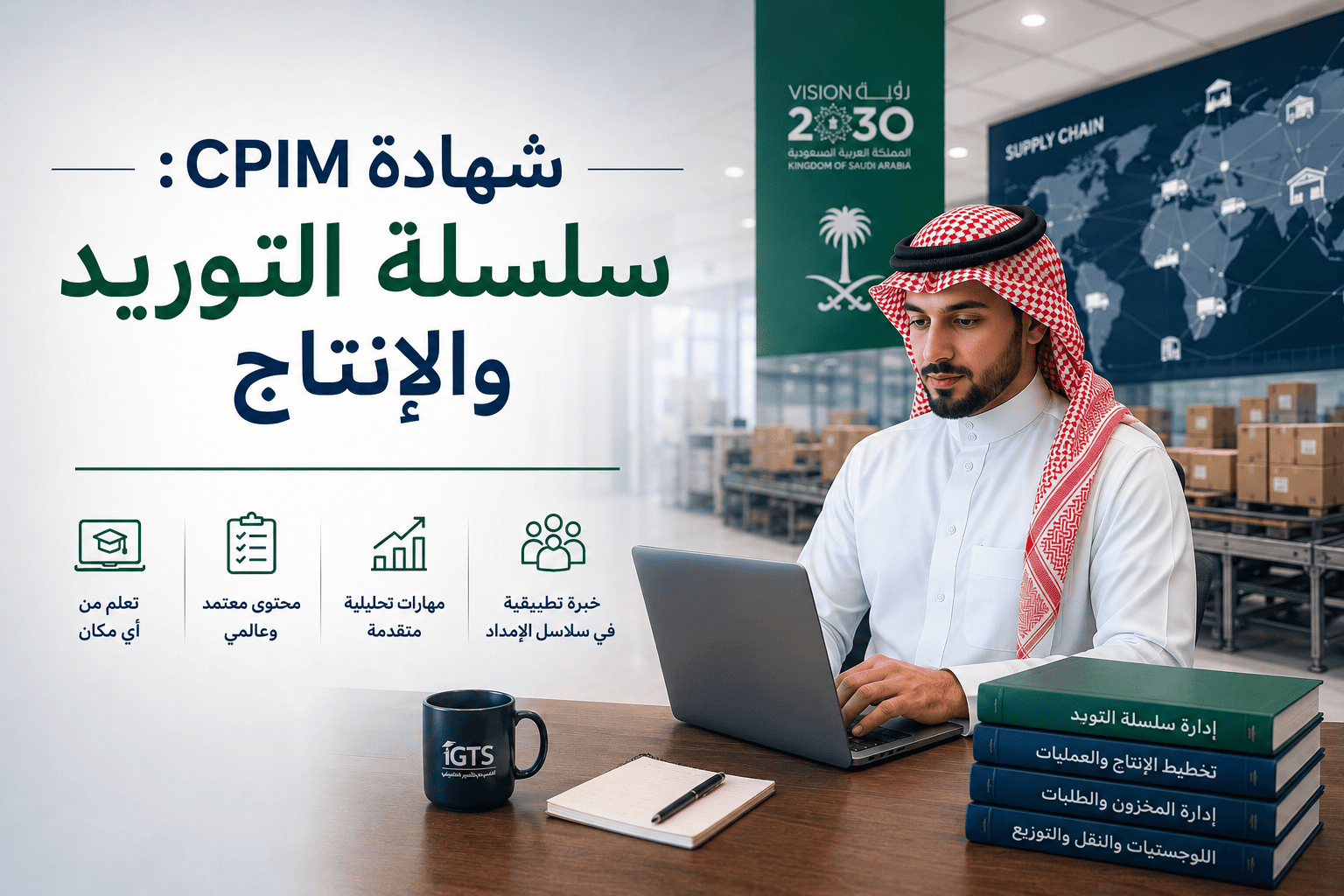
CPIM Certification: Supply Chain and Production
Supply chain and production management have become among the most influential fields in the success of organizations, especially with the acceleration of digital transformation and the development of the industrial and logistics sectors in Saudi Arabia. Companies are no longer looking only for employees with experience, but for professionals who are capable of improving planning, production, and inventory management according to global best practices.
This is where the CPIM certification stands out as one of the most important professional certifications specialized in production planning and inventory management. It gives holders a deep understanding of how to manage operational processes within industrial organizations, manufacturing companies, and supply chains.
But is CPIM suitable for you? What is the difference between CPIM and CSCP? And does it have real value in the Saudi job market?
In this guide, you will learn everything you need before deciding to study for the CPIM certification, starting from its nature and requirements, all the way to job opportunities and expected salaries in the Kingdom.
What Is the CPIM Certification?
CPIM stands for Certified in Planning and Inventory Management. It is a globally recognized professional certification offered by ASCM, the Association for Supply Chain Management, and it focuses on developing the skills of professionals in production planning, inventory management, and operational processes within organizations.
This certification is considered one of the most popular certifications among professionals working in:
- Factories.
- Manufacturing companies.
- Food and pharmaceutical companies.
- Retail companies.
- Logistics services.
- Oil and gas sectors.
- Heavy industries.
Unlike some supply chain certifications that focus on managing the entire network, CPIM focuses on the internal operations of the organization, starting from demand forecasting to delivering the final product.
What Will You Learn in the CPIM Certification?
The certification content covers a set of topics that every operations management specialist needs, such as:
- Demand planning.
- Inventory management.
- Production capacity planning.
- Resource management.
- Production scheduling.
- Improving operational processes.
- Measuring operational performance.
- Quality management within production.
- Operational risk management.
- Continuous improvement.
The goal is to help organizations produce the right quantities, at the right time, and at the lowest possible cost.
Why Is CPIM Highly Important?
Many companies suffer from:
- High storage costs.
- Product shortages.
- Production delays.
- Poor planning.
- Increased waste.
The CPIM certification helps specialists address these challenges using global methodologies that have proven successful across different sectors.
For Saudi companies, these skills have become even more important with the expansion of industrial and logistics projects within the objectives of Saudi Vision 2030, which focuses on strengthening local manufacturing, improving supply chain efficiency, and transforming the Kingdom into a global logistics hub.
Read Also
CPIM or CSCP: Which One Is Right for You?
Many professionals confuse CPIM and CSCP because both are issued by ASCM, but each certification has a different purpose.
| Element | CPIM | CSCP |
|---|---|---|
| Focus | Internal operations and production | The entire supply chain |
| Target Audience | Production, planning, and inventory | Supply chain management and strategy |
| Study Level | Operational and practical | Strategic and managerial |
| Best Suited For | Factories and production | Supply chain managers |
| Topics | Production, inventory, quality | Suppliers, transportation, global planning |
When Should You Choose CPIM?
CPIM is the right choice if you work in:
- Production planning.
- Inventory management.
- Manufacturing.
- Operations monitoring.
- Warehouse management.
- Operational planning.
It is also suitable for those who want to specialize technically within factories and production companies.
When Is CSCP a Better Option?
If your work is related to:
- Supplier management.
- Logistics services.
- Transportation.
- Strategic planning.
- Global supply chain.
Then CSCP may be the more suitable option for your career path.
For this reason, many professionals prefer to start with CPIM and later move on to CSCP after gaining managerial experience.
How Do You Choose Between the Two Certifications?
Ask yourself these questions:
- Do I work inside a factory, or do I manage the entire supply chain?
- Do I focus on improving production, or on managing suppliers?
- Do I aspire to an operational path or a managerial path?
- What type of jobs am I targeting in the coming years?
Answering these questions helps you choose the certification that brings the greatest value to your career path, instead of relying only on the popularity of the certification.
Why Is Demand for CPIM Increasing in Saudi Arabia?
The Saudi job market is witnessing major expansion in the industrial and logistics sectors, supported by Vision 2030 initiatives and investments in industrial cities and logistics zones.
As a result, companies are looking for professionals who are capable of:
- Reducing waste.
- Increasing production efficiency.
- Improving inventory management.
- Supporting digital transformation in operations.
- Improving operational performance indicators.
All of these are skills that the CPIM certification directly covers.
CPIM Certification Requirements
One of the advantages of the CPIM certification is that it does not require a specific university qualification or a fixed number of years of experience to register for the exam, making it suitable for professionals at different stages of their careers.
However, having practical experience in production, planning, or inventory helps you understand the content better and connect the concepts to daily applications.
Before applying for the exam, it is preferable to have basic knowledge of:
- Supply chain management principles.
- Production planning.
- Inventory management.
- Operational processes.
- Operational performance indicators, or KPIs.
It is also recommended to enroll in a specialized training program that covers all certification areas and prepares you for the exam in a practical and organized way.
What Does the CPIM Certification Content Include?
The curriculum focuses on the full production cycle within the organization and covers topics such as:
- Sales and Operations Planning, or S&OP.
- Demand management and sales forecasting.
- Resource and production planning.
- Production capacity management.
- Inventory management.
- Quality improvement.
- Continuous Improvement.
- Operational risk management.
- Performance measurement indicators.
The goal is not only to pass the exam, but also to gain tools that help you improve operational performance within the organization.
How Can You Prepare for the CPIM Exam?
Success in the exam does not depend on memorization, but on understanding how to apply concepts in the work environment.
You can follow the following plan:
1. Create a Clear Study Schedule
Set fixed weekly study hours and divide the content into small units that are easy to review.
2. Use Official Materials
Make sure to study from ASCM-approved sources, because they cover all exam areas and use the terminology that appears in the questions.
3. Practice with Mock Exams
Solving as many practice questions as possible helps you:
- Understand the exam style.
- Manage your time during the test.
- Identify weaknesses before the exam date.
4. Connect Concepts to Your Work
If you work in a factory, warehouse, or planning department, try to apply the concepts you study to the actual operations inside your company, because this makes them easier to understand and remember.
CPIM Job Opportunities in Saudi Arabia
The significant growth in the industrial sector and logistics services has increased demand for specialists in planning, production, and inventory management.
For this reason, the CPIM certification gives you a competitive advantage when applying for many jobs, especially in companies that depend on manufacturing or complex supply chains.
Some of the most prominent roles that benefit from the certification include:
- Production Planner.
- Material Planner.
- Inventory Management Specialist.
- Warehouse Supervisor.
- Demand Planning Manager.
- Operations Manager.
- Supply Chain Manager.
- Production Manager.
- Logistics Manager.
- Operations Analyst.
The value of the certification also increases in sectors such as:
- Manufacturing industries.
- Petrochemicals.
- Food industries.
- Pharmaceutical industries.
- E-commerce.
- Transportation and logistics companies.
Average Salaries for CPIM Holders in Saudi Arabia
Salary depends on years of experience, company size, sector, and job responsibilities. However, in general, CPIM holders often have better opportunities for career growth compared to those who do not hold specialized professional certifications.
Approximate monthly salaries in the Saudi market are as follows:
| Job Title | Average Monthly Salary |
|---|---|
| Production Planning Specialist | SAR 8,000 – 13,000 |
| Inventory Specialist | SAR 8,500 – 14,000 |
| Supply Chain Planner | SAR 10,000 – 16,000 |
| Operations Manager | SAR 15,000 – 25,000+ |
| Supply Chain Manager | SAR 18,000 – 35,000+ |
Note: These figures vary depending on the sector, organization size, and practical experience, and do not depend on the certification alone.
Is the CPIM Certification Worth the Investment?
If your goal is to build a career path in production, inventory management, or operational planning, CPIM is one of the most valuable certifications.
However, if you are targeting supply chain management at a strategic level that includes suppliers, transportation, and global operations, CSCP may be a more suitable option.
Therefore, the decision depends on the nature of your current role and the path you plan to reach in the coming years.
If you also want to learn about the most suitable certification for professionals in comprehensive supply chain management, you can read the article on the CSCP certification to understand the differences between the two certifications and choose the one that best fits your career path.
You can also browse the IGTS Diplomas page to learn about training programs that help you develop your skills in management, supply chain, and operational processes.
Frequently Asked Questions
What Is the CPIM Certification?
CPIM is a globally recognized professional certification offered by ASCM. It focuses on production planning, inventory management, and improving operational processes within organizations. It is considered one of the most prominent certifications for professionals working in manufacturing and supply chain.
What Is the Difference Between CPIM and CSCP?
CPIM focuses on production management and internal operations, while CSCP focuses on managing the entire supply chain, including suppliers, logistics services, and strategic planning. Choosing between them depends on the nature of your work and your career goals.
How Much Does the CPIM Certification Cost?
The cost of CPIM varies depending on the training provider, exam fees, and whether you are an ASCM member or not. Therefore, it is preferable to check with the training provider or the official website for the latest prices.
Is CPIM Recognized in Saudi Arabia?
Yes, CPIM is widely recognized by many companies operating in the industrial, manufacturing, and logistics sectors within the Kingdom, especially organizations that apply global best practices in operations and supply chain management.
How Much Does a CPIM Holder Earn in Saudi Arabia?
There is no fixed salary for CPIM holders, but having the certification may improve your chances of reaching roles with higher responsibilities and better salaries, especially when combined with practical experience in production and supply chain fields.
Develop Your Expertise in Production and Supply Chain Management with IGTS
If you are looking to develop your expertise in supply chain, operations management, and production, having practical knowledge alongside professional certifications helps you compete in the job market, especially with the major expansion taking place in the logistics and industrial sectors in Saudi Arabia.
Start your journey with IGTS training programs, and benefit from practical training content that helps you build your skills in management, planning, process improvement, and prepare for professional development with confidence.
Start Now
Develop your career path through professional certifications and diplomas with IGTS, and choose the program that best matches your goals in management, supply chain, leadership, and business.
Updated at: 2026-09-19 06:51:07