
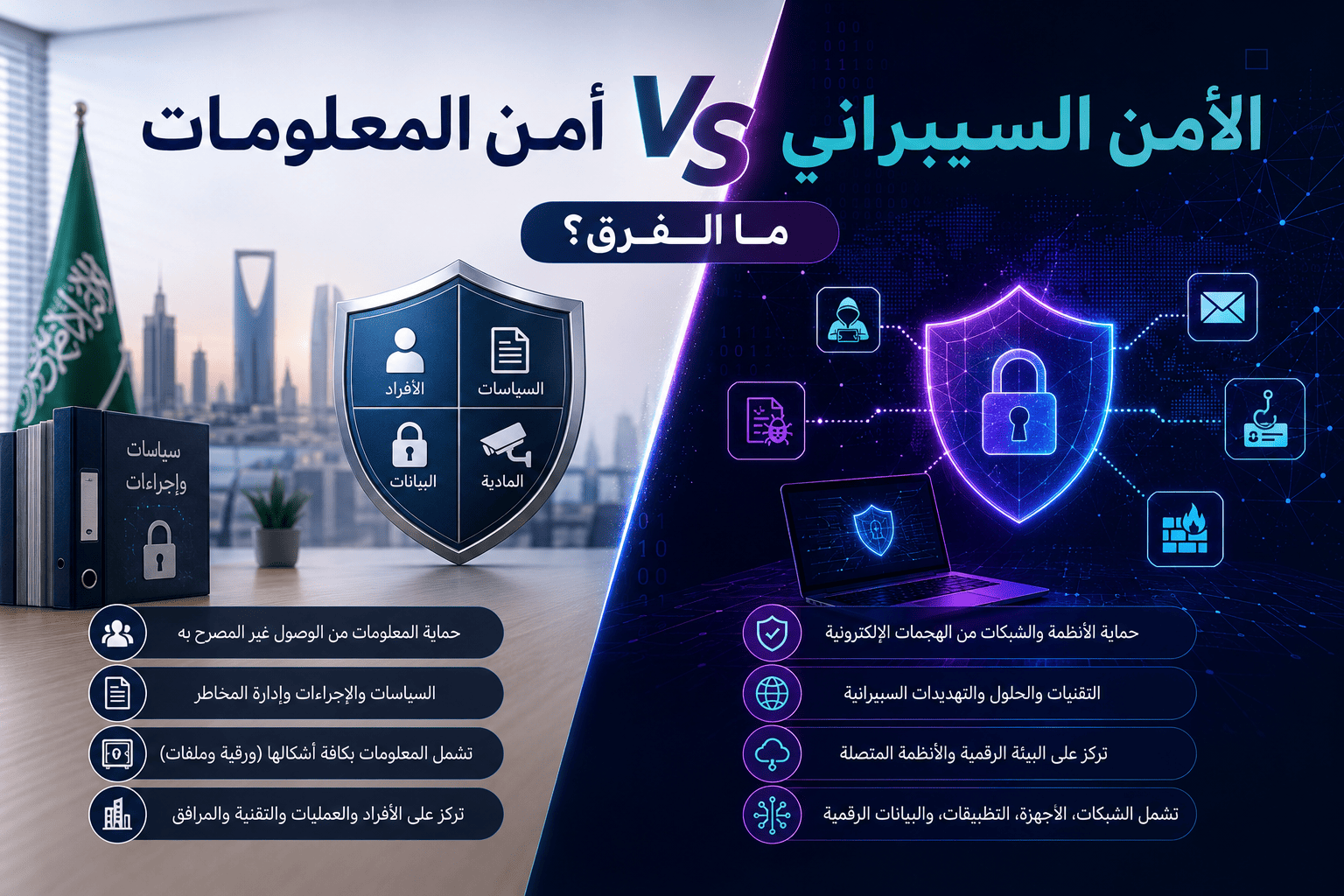
Information Security vs Cybersecurity: What Is the Difference?
With the expansion of digital transformation and organizations’ reliance on electronic systems, terms such as information security and cybersecurity have become increasingly common in jobs, training courses, and professional certifications. Although many people use the two terms with the same meaning, there are fundamental differences between them in terms of scope, objectives, and responsibilities.
In Saudi Arabia, demand is increasing for specialists in both fields as government and private sectors continue implementing Saudi Vision 2030 initiatives, which focus on building a secure digital infrastructure and strengthening national capabilities in digital security.
If you are thinking about working in this field or want to develop your skills, it is important to understand the difference between information security and cybersecurity so you can choose the path that matches your interests and professional ambitions.
Definition of Information Security
Information security refers to a set of policies, procedures, and technologies that aim to protect information in all its forms, whether digital or paper-based, from unauthorized access, modification, loss, or destruction.
In other words, information security focuses on protecting the information itself, regardless of where it exists or the medium on which it is stored.
This field is based on three main principles known as the CIA Triad:
Confidentiality
This means that information can only be accessed by authorized individuals.
Examples include:
- Defining user permissions.
- Encrypting sensitive files.
- Using strong passwords.
Integrity
This means maintaining the accuracy of data and ensuring that it is not modified or deleted without authorization.
This can be achieved through:
- Identity verification systems.
- Change logs.
- Backups.
- File integrity checks.
Availability
This means ensuring that information can be accessed when needed without interruption.
This includes:
- Business continuity plans.
- Backup systems.
- Backup data centers.
- Disaster recovery.
Where Is Information Security Used?
Information security principles are applied in almost all organizations, including:
- Banks.
- Hospitals.
- Government entities.
- Universities.
- Private companies.
- Financial institutions.
Its role is not limited to protecting digital data only; it also includes paper documents, contracts, records, and any information that has value to the organization.
Definition of Cybersecurity
Cybersecurity is one of the specializations related to protecting digital systems, networks, devices, and applications from cyberattacks, breaches, and malicious software.
This field focuses on protecting the digital environment through which information is stored, processed, or transmitted.
Its key responsibilities include:
- Protecting networks.
- Securing servers.
- Protecting applications.
- Detecting cyberattacks.
- Responding to security incidents.
- Penetration testing.
- Managing security vulnerabilities.
- Monitoring security systems.
With the global increase in cyberattacks, cybersecurity has become one of the fastest-growing fields in the Saudi job market.
Key Cybersecurity Specializations
Cybersecurity includes several career paths, most notably:
Network Security
This focuses on protecting network infrastructure and preventing unauthorized access.
Penetration Testing
This relies on simulating cyberattacks to discover weaknesses before they are exploited.
Security Incident Response
This focuses on detecting, analyzing, containing, and reducing the impact of attacks.
Cloud Security
This focuses on protecting data and services hosted on cloud computing platforms.
Application Security
This focuses on detecting security vulnerabilities in software before it is released to users.
Why Is Demand for Cybersecurity Increasing in Saudi Arabia?
The Saudi market is witnessing continuous growth in the need for cybersecurity specialists as a result of:
- The expansion of digital services.
- The spread of cloud computing.
- Increasing reliance on artificial intelligence.
- The rising number of cyberattacks.
- The expansion of digital government services.
- The implementation of security and compliance requirements across various sectors.
Organizations are now looking for professionals who possess the practical skills needed to protect systems and sensitive data from growing threats.
The Difference Between Information Security and Cybersecurity
After understanding the concept of each field, it becomes clear that there is a close relationship between them, but they are not the same thing. Cybersecurity is part of the broader information security framework, while information security extends to protecting information in all its forms, whether digital or non-digital.
To explain the differences simply, here is the following comparison:
| Comparison Point | Information Security | Cybersecurity |
|---|---|---|
| Main Objective | Protecting information in all its forms | Protecting digital systems, networks, and data |
| Scope of Work | Includes paper-based and digital information | Limited to the digital environment |
| Focus | Confidentiality, integrity, and availability | Preventing, detecting, and responding to cyberattacks |
| Nature of Risks | Data loss, leakage, or manipulation | Breaches, malware, and ransomware attacks |
| Work Areas | Governance, compliance, risk management, information security | Penetration testing, network security, application security, Security Operations Center (SOC) |
In short, if an organization wants to protect all its information assets, it needs information security. However, if the goal is to protect digital systems from cyber threats, cybersecurity is the specialization most closely related to that objective.
The Relationship Between Information Security and Cybersecurity
One common mistake is assuming that there is competition between the two fields, while in reality, they complement each other.
For example, a company may rely on information security policies that define who has the right to access customer files, while the cybersecurity team uses tools and technologies to protect the servers and networks where those files are stored.
Therefore, modern organizations rely on the integration of both fields to build a complete security system that combines policy development, risk management, technical control implementation, and response to cyber threats.
Which Career Path Is Right for You?
Choosing between information security and cybersecurity depends on your interests, the type of work you prefer, and the skills you want to develop.
Information security may be suitable for you if you are interested in:
- Developing policies and procedures.
- Risk management.
- Governance and compliance.
- Internal auditing.
- Protecting data at the organizational level.
Cybersecurity may be the better option if you enjoy:
- Technical work.
- Analyzing cyberattacks.
- Protecting networks.
- Penetration testing.
- Analyzing security vulnerabilities.
- Monitoring security systems.
In many cases, specialists begin in one field and later develop their experience to work in the other, especially since the core skills overlap across many jobs.
Skills Required in Both Fields
Regardless of the path you choose, there are several skills that give you a strong foundation, including:
- Analytical thinking.
- Problem-solving.
- Risk management.
- Understanding networking fundamentals.
- Familiarity with security concepts.
- Continuous learning.
- The ability to deal with modern technologies.
If you choose cybersecurity, you will also need to develop deeper technical skills, such as system administration, programming fundamentals, and vulnerability analysis.
The Future of Both Fields in Saudi Arabia
The Kingdom continues to invest in digital security as part of the objectives of Saudi Vision 2030. This is reflected in the growing demand for qualified professionals specialized in protecting information and digital systems.
Government entities and major companies are working to strengthen their capabilities in security, compliance, and risk management, while also expanding cybersecurity teams to face increasing threats.
Therefore, whether you choose to specialize in information security or cybersecurity, professional growth opportunities in the Saudi market look promising in the coming years, especially for those who continue developing their skills and keeping up with the latest practices and technologies.
Read Also
Frequently Asked Questions
What Is Information Security?
Information security is a set of policies, procedures, and technologies that aim to protect information from unauthorized access, modification, or loss, whether this information is stored digitally or in paper documents.
What Is the Difference Between Information Security and Cybersecurity?
Information security focuses on protecting information itself regardless of its form, while cybersecurity focuses on protecting systems, networks, devices, and digital data from cyberattacks and electronic threats.
Which Is Better to Specialize In?
There is no field that is absolutely better than the other. It depends on your professional interests. If you prefer administrative aspects, governance, and risk management, information security may suit you. However, if you are interested in technical work, attack analysis, and system protection, cybersecurity may be the better option.
Can You Specialize in Both?
Yes. Many specialists combine the fundamental concepts of both fields, especially as the required skills overlap in many jobs related to digital security, risk management, and compliance.
How Much Does an Information Security Specialist Earn in Saudi Arabia?
Salary varies depending on years of experience, professional certifications, job type, and the sector you work in. In general, information security and cybersecurity roles are considered among the jobs with competitive salaries in the Saudi market, especially with the increasing demand for specialized professionals.
Develop Your Professional Future with IGTS
If you are thinking about building a career path in information security or cybersecurity, having foundational knowledge and practical skills will help you choose the right specialization and prepare for the requirements of the Saudi job market, which is witnessing increasing demand for qualified professionals in digital security and information protection.
Start your journey with IGTS Cybersecurity Programs and Courses, and benefit from training content that introduces you to the core concepts, best practices, and latest trends in protecting systems and data, supporting your professional development in this field.
Start Now
Develop your skills in cybersecurity and information security through IGTS training programs and courses, and choose the program that matches your level and professional goals.
Updated at: 2026-10-05 15:55:14