
Tags
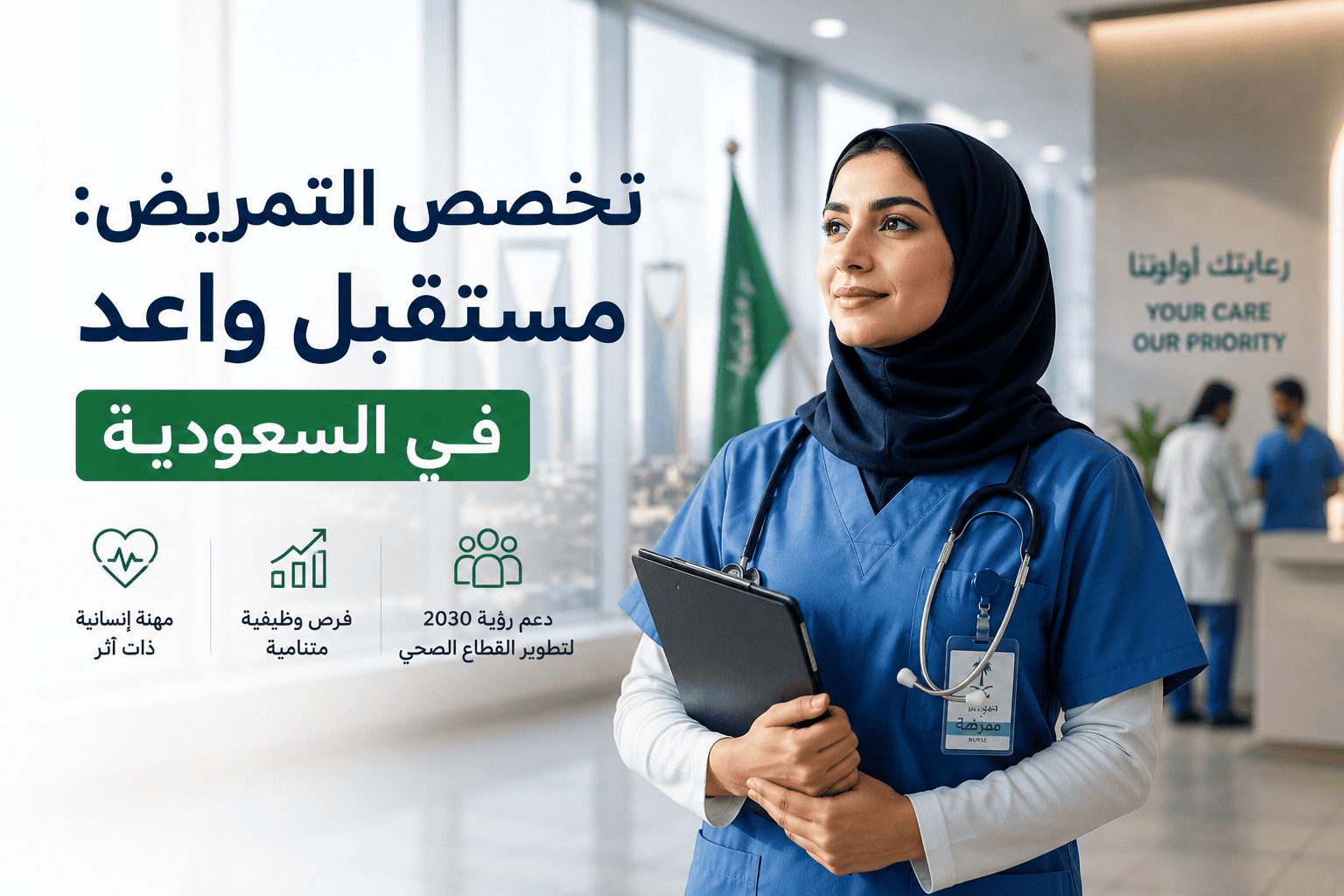
Nursing: A Promising Career Path in Saudi Arabia
Nursing is no longer limited to providing care for patients inside hospitals. It has become one of the main pillars in developing the healthcare sector in Saudi Arabia. With the expansion of medical cities, specialized hospitals, primary care centers, and digital health services, demand has increased for qualified nursing professionals who are able to keep pace with this development.
The healthcare sector receives major attention within Saudi Vision 2030, which aims to improve the quality of health services, increase the efficiency of national talent, and expand investment in the sector. For this reason, studying nursing has become an option that combines job stability, professional growth opportunities, and the possibility of specializing in diverse fields that suit each practitioner’s interests.
If you are a student thinking about entering the field, or a nurse who wants to develop your career path, this guide will help you understand the nature of the nursing specialization, its main branches, the opportunities available in the Saudi job market, and how you can strengthen your expertise through training and professional certifications.
What Is the Nursing Specialization?
Nursing is one of the healthcare specializations concerned with providing preventive, therapeutic, and rehabilitative care to patients, in cooperation with doctors and other members of the medical team. The nurse’s role includes monitoring the patient’s health condition, implementing the treatment plan, educating patients, contributing to disease prevention, and promoting health.
However, today’s practical reality is much broader than that. A nurse may work in an operating room, emergency department, specialized clinic, intensive care unit, or even in quality management, training, and scientific research.
For this reason, nursing is considered one of the most diverse specializations, as it gives graduates multiple career options instead of limiting them to a single career path.
Skills Needed by a Successful Nurse
A nurse’s success does not depend on medical knowledge only, but also on a set of skills that directly affect the quality of healthcare, including:
- Effective communication with patients and their families.
- Quick decision-making in emergency cases.
- Working within a multidisciplinary team.
- Time management and priority organization.
- Accuracy in following medical procedures.
- The ability to handle work pressure.
- Commitment to professional ethics and confidentiality of information.
These skills have become among the essential requirements that healthcare employers look for during recruitment, alongside academic qualifications and practical training.
Also Read
Nursing Subspecialties
One of the most important advantages of the nursing specialization is that it allows practitioners to develop their path in the field that matches their professional interests. After gaining basic experience, nurses can move into one of the specialized areas that are witnessing increasing demand in the Kingdom.
Emergency Nursing
This focuses on dealing with critical cases and sudden injuries. It requires fast response, decision-making, and the ability to work under pressure.
Intensive Care Nursing
This specializes in caring for critically ill patients inside intensive care units, while continuously monitoring vital signs and medical devices.
Pediatric Nursing
This focuses on caring for children from birth through different age stages, combining medical knowledge with the ability to communicate with the child and their family.
Women’s Health and Maternity Nursing
This focuses on caring for women during pregnancy, childbirth, and the postpartum period, in addition to monitoring the health of the mother and child.
Mental Health Nursing
This involves working with patients who suffer from psychological or behavioral disorders and participating in implementing treatment plans and psychological support.
Community Health Nursing
This focuses on prevention and health awareness within the community, and participation in health campaigns and preventive programs.
Operating Room Nursing
This involves preparing operating rooms, monitoring instrument sterilization, and supporting the surgical team before, during, and after surgery.
Oncology Nursing
This specializes in caring for cancer patients, monitoring treatment, and providing health and psychological support throughout the different stages of treatment.
How Do You Choose the Right Specialization?
Choosing the right specialization does not depend on the most popular field, but on several factors, such as:
- The type of work environment you prefer.
- The skills you are good at.
- Career growth opportunities.
- Job market needs.
- Your long-term career plan.
The more experience you gain, the easier it becomes to identify the field that suits you and invest in developing your skills within it.
Nursing Job Opportunities in Saudi Arabia
The healthcare sector in the Kingdom is witnessing a major transformation driven by the objectives of Saudi Vision 2030, which focuses on improving the quality of health services, increasing facility efficiency, and improving the patient experience, alongside the expansion of hospitals and medical and specialized centers.
This expansion has directly increased demand for nursing professionals, whether in the government or private sector. Employment is no longer limited to general hospitals as it was in the past.
Today, a male or female nurse can build a career path in diverse work environments, with the possibility of moving between specialties or progressing into supervisory and administrative roles after gaining experience.
Where Can Nursing Graduates Work?
Employment opportunities in Saudi Arabia include:
- Government hospitals.
- Private hospitals and medical complexes.
- Primary healthcare centers.
- Dialysis centers.
- Rehabilitation and physiotherapy centers.
- Specialized clinics.
- Home care centers.
- Blood banks.
- School and university health centers.
- Healthcare companies.
- Military entities and security sectors.
- Health insurance companies.
- Educational and training institutions.
This diversity provides great flexibility in choosing the work environment that matches your interests and professional goals.
Key Available Jobs
After studying nursing and gaining the required experience, nurses can work in several roles, such as:
| Job Title | Nature of Work |
|---|---|
| General Nurse | Providing daily nursing care and following up on the implementation of the treatment plan |
| Emergency Nurse | Dealing with critical cases and sudden injuries |
| Intensive Care Nurse | Monitoring patients in intensive care units |
| Operating Room Nurse | Preparing operating rooms and supporting the surgical team |
| Pediatric Nurse | Caring for children at different age stages |
| Mental Health Nurse | Providing care for psychiatric patients and following up on treatment plans |
| Nursing Supervisor | Supervising nursing teams and ensuring performance quality |
| Health Educator | Educating patients and the community about prevention and health promotion |
With career progression, nurses can move into positions such as Nursing Manager, Quality Manager, or Health Services Manager, especially after completing further study or obtaining specialized professional programs.
Nursing Salaries in Saudi Arabia
Nursing salaries in Saudi Arabia are among the topics most searched by those who want to enter the field, but there is no fixed value that applies to all roles.
Salary is affected by several factors, including:
- Academic qualification.
- Years of experience.
- Subspecialty.
- City.
- Government or private sector.
- Type of healthcare facility.
- Shifts and working hours.
- Allowances and benefits.
Average Nursing Salaries in Saudi Arabia
According to employment data commonly circulated in the Saudi job market, the approximate salary ranges can be summarized as follows:
| Experience Level | Approximate Average Monthly Salary |
|---|---|
| Recent graduate | SAR 7,000 to 9,000 |
| 3 to 5 years of experience | SAR 9,000 to 13,000 |
| More than 5 years of experience | SAR 13,000 to 18,000 or more |
| Supervisory and administrative roles | May exceed SAR 20,000 depending on the employer and position |
Note: These figures are approximate and reflect common ranges in the Saudi job market. They may vary depending on the employer, years of experience, allowances, and job benefits.
How Can You Increase Your Chances of Earning a Higher Salary?
Getting a better salary is not linked only to years of experience. It also depends on continuous investment in skill development.
Some of the key factors that enhance your professional value include:
- Obtaining accredited professional certifications.
- Specializing in one of the precise nursing fields.
- Developing leadership and supervision skills.
- Mastering English in the medical environment.
- Gaining experience in specialized hospitals.
- Participating in continuing education programs.
Every developmental step you add to your experience may reflect positively on promotion opportunities, the responsibilities you take on, and therefore your income level.
How Can You Develop Your Nursing Career Path?
Entering the job market is only the beginning. Professional development requires a clear plan that helps you gain new experience and keep up with continuous changes in the healthcare sector.
You can build a stronger career path through five practical steps:
1. Define the Field You Want to Specialize In
After gaining basic experience, choose the field that aligns with your interests, such as emergency, intensive care, pediatrics, or mental health, then focus on developing your knowledge in it.
2. Commit to Continuous Education
The healthcare sector develops quickly, so it is important to follow training programs that add new skills in clinical practice, patient safety, quality management, and modern health technologies.
3. Develop Your Leadership Skills
If you aspire to supervision or management, you will need skills that go beyond the clinical side, such as:
- Managing work teams.
- Problem-solving.
- Decision-making.
- Planning.
- Time management.
- Effective communication.
4. Obtain Accredited Training Programs
Alongside academic study, professional programs help bridge the gap between theoretical knowledge and daily work requirements.
If you are looking for a program that helps you build a strong foundation in the field, you can learn about the Nursing Diploma from IGTS, which focuses on developing the knowledge and skills related to professional practice.
Those who want to move in the future into administrative positions inside healthcare facilities can also benefit from the Hospital Management Diploma article to learn about the skills required to manage healthcare institutions and lead work teams.
5. Build a Long-Term Career Plan
Ask yourself where you want to be in five years.
Your goal may be to work in a specialized hospital, lead a nursing team, specialize in a precise field, or move into healthcare administration.
Having a clear vision helps you choose the courses, certifications, and experiences that bring you closer to this goal, instead of developing skills that do not serve your career path.
Frequently Asked Questions
What Are the Nursing Specializations?
The nursing specialization includes a large number of career paths, and nurses usually choose the right specialization after gaining basic experience or completing specialized training programs. Some of the most prominent specializations include:
- Emergency nursing.
- Intensive care nursing.
- Pediatric nursing.
- Women’s health and maternity nursing.
- Mental health nursing.
- Operating room nursing.
- Oncology nursing.
- Community health nursing.
- Geriatric nursing.
- Home care nursing.
Choosing the specialization depends on the practitioner’s interests, the nature of the work environment, and the opportunities available in the job market.
How Much Does a Nurse Earn in Saudi Arabia?
Nursing salaries in Saudi Arabia vary depending on the employer, years of experience, qualification, specialization, and job allowances.
In general, the salary of a newly graduated nurse starts from around SAR 7,000 per month in some organizations, while it can exceed SAR 20,000 in supervisory or specialized roles, especially with experience and professional certifications.
Is Online Nursing Available in Saudi Arabia?
Studying nursing depends on a practical and clinical component that cannot be replaced. Therefore, the full academic specialization is not offered entirely through online learning.
On the other hand, many online professional programs and diplomas are available to help healthcare workers develop their knowledge in areas such as quality, patient safety, healthcare administration, and nursing skills, without being a substitute for the clinical training required to obtain the academic qualification or professional license.
What Is the Best Nursing Certification?
There is no single certification that suits all nurses. The best option depends on the professional stage and career goal.
At the beginning of their career, a nurse may need programs that strengthen essential skills, while experienced professionals may focus on certifications related to subspecialties, leadership, or healthcare administration.
Therefore, it is better to choose the program that supports the path you are planning, instead of relying only on the popularity of the certification.
Is Nursing in Demand in Saudi Arabia?
Yes, nursing remains one of the specializations with continuous demand in the Kingdom, supported by the expansion of health services, the increase in the number of medical facilities, and the focus on improving the quality of healthcare within the objectives of Saudi Vision 2030.
The need for qualified professionals is increasing across different nursing specializations, especially in specialized hospitals, primary care centers, home care, and specialized health services.
The Future of Nursing Starts with Continuous Development
Choosing nursing does not only mean getting a job. It means entering a profession that continuously develops and provides broad opportunities for learning, specialization, and career growth. With continued investment in the Saudi healthcare sector, the need for qualified nurses is greater than ever, whether in clinical care, subspecialties, or administrative positions.
The more you focus on developing your skills, gaining practical experience, and keeping up with the latest healthcare practices, the greater your chances of building a stable career path and achieving sustainable professional progress.
Get the Accredited Nursing Diploma and Register with IGTS
If you want to develop your knowledge of the field or strengthen your professional skills, the Nursing Diploma from IGTS provides training content that helps you build a strong foundation in the field, with a focus on the skills needed by the job market.
If you are planning in the future to move into the administrative side of the healthcare sector, make sure to also read the Hospital Management Diploma article to learn about the skills that qualify you to lead healthcare facilities and manage work teams efficiently.
Start Now
Develop your nursing career and gain the skills that help you advance professionally in the healthcare sector.
Updated at: 2026-10-10 06:55:00