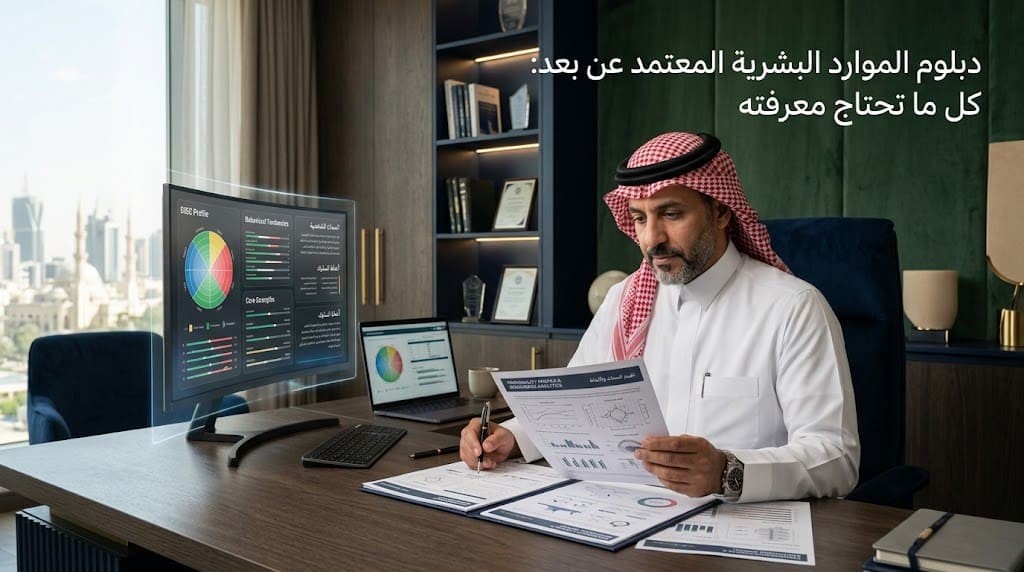
Accredited Online HR Diploma: Everything You Need to Know
If you are thinking about entering the Human Resources field or want to move into it from another specialization, a remote Human Resources diploma may be a practical option for building a clear professional foundation without being tied to daily attendance at an educational institution.
However, choosing a diploma should not depend only on the word "accredited" or on the number of subjects. What matters most is what you will actually learn and how closely the content relates to the tasks performed by Human Resources professionals in the workplace.
This is particularly important if you are at the beginning of your professional career, already working and want to develop your role, or are looking for flexible study alongside your job.
In this guide, we will focus on the aspects that matter when making your decision, from the diploma content and remote study format to the skills it may add to your career path and when the diploma is actually suitable for you.
What Is a Remote Human Resources Diploma?
A Human Resources diploma is a training program that focuses on the fundamentals and practices of Human Resources Management, such as recruitment, employee management, training and development, performance evaluation, and other topics related to the employee lifecycle within an organization.
Remote study means that learning takes place electronically, making it a suitable option for those who need greater flexibility in organizing their time.
However, the value of the diploma does not come from the study method alone. The content is the most important factor.
If you are going to study Human Resources, you do not only need to know the terminology. You need to understand how these concepts appear in everyday workplace situations and how Human Resources decisions relate to the needs of the organization and its employees.
What Do You Study in an HR Diploma?
Subjects vary from one program to another, so it is better to review the study plan before registering. However, the content usually revolves around a number of core areas of Human Resources Management, such as:
Human Resources Planning
Before an organization begins recruiting, it needs to understand its actual needs. How many employees does it need? What skills are required? Is the problem a shortage of employees or a shortage of a particular skill?
Understanding these questions gives you a clearer picture of the role of HR in planning instead of viewing it only as a department responsible for administrative procedures.
Recruitment and Talent Acquisition
Recruitment does not begin with the job interview. There is a process of identifying the need, writing the job description, searching for candidates, screening applications, and then conducting interviews and making a selection.
Studying this stage helps you understand how an organization moves from having a vacant position to selecting the right person for it.
Performance Management
Employee evaluation should not simply be a form completed at the end of the year. Performance Management is connected to setting expectations, monitoring results, providing feedback, and identifying areas for development.
This is where a Human Resources professional begins to treat performance as a continuous process rather than a separate procedure.
Training and Development
If an organization wants to develop its employees, it first needs to understand the gap between their current skills and the skills required. Training is therefore connected to analyzing needs, designing suitable programs, and then monitoring their impact.
This knowledge is particularly useful for someone who wants to work in Learning and Development within Human Resources.
Compensation and Benefits
Pay and benefits are among the most sensitive aspects of the relationship between an employee and an organization. An HR professional needs to understand the fundamental principles related to compensation and benefits and how they influence attracting and retaining employees.
Employee Relations
Human Resources also deals with situations that arise within the workplace. These may involve a disagreement between employees, a complaint, a communication problem, or the need to clarify an internal policy.
A Human Resources professional therefore needs communication, listening, and professional interpersonal skills for dealing with different situations.
Is Remote Study Suitable for You?
This point is more important than it may seem. Remote study is not the best option for everyone, but it may be highly suitable if your circumstances do not allow you to attend in person.
A remote HR diploma may suit you if you:
- Work full-time and need to organize your studies around working hours
- Are a recent graduate and want to add specialized study to your current qualification
- Work in another field and are considering moving into Human Resources
- Want to develop your knowledge without committing to daily attendance
- Prefer online learning and can commit to an independent study plan
On the other hand, if you need continuous face-to-face interaction or find it difficult to commit to self-directed learning, it is better to consider the nature of online learning as one of the factors in your decision.
Human Resources Diploma or Master's Degree?
The purpose of a diploma is not to be a shorter version of a master's degree. Each serves a different objective, so there is no single answer that suits everyone.
| Comparison | Human Resources Diploma | Master's in Human Resources Management |
|---|---|---|
| Primary Objective | Build or develop a professional foundation in HR | More advanced and specialized academic study |
| Duration and Commitment | Usually less than master's programs | Requires a greater study commitment |
| Suitable for Recent Graduates | Yes, depending on program requirements | Depends on admission requirements |
| Suitable for Career Transition | A practical option for getting started | May suit those targeting a broader academic or specialized pathway |
| Nature of Study | Greater focus on fundamentals and application | Greater depth in management and advanced topics |
| Appropriate Decision | When you want to develop your foundation or enter the field | When your objective is to obtain a postgraduate degree |
Therefore, if your current objective is to learn about the field and gain a foundation in the Human Resources specialization, a diploma may be a suitable starting point.
However, if you have a specific academic objective or need a master's degree for your professional path, you will need to compare programs and admission requirements separately.
What Professional Benefits Can You Gain from Studying Human Resources?
The main advantage of a diploma is not simply that it adds another line to your CV. What matters is the knowledge you can use after studying.
For example, when you understand the recruitment cycle, it becomes easier to follow the talent acquisition process from the beginning instead of treating the interview as an isolated step. When you understand Performance Management, you will be better able to read performance indicators and feedback. When you study Training and Development, you will understand why sending employees to a training course is not enough without identifying the need for it or understanding its results.
This integrated picture helps you understand the HR function as part of the organization's work rather than as a department separate from its objectives.
What Jobs Can Be Related to Studying Human Resources?
Job titles and opportunities vary depending on qualifications, experience, sector, and the requirements of each role.
Career paths related to Human Resources include:
- Human Resources Specialist
- Recruitment Officer
- Talent Acquisition Specialist
- Training and Development Specialist
- Employee Relations Officer
- Human Resources operations support roles
As experience is gained, the career path may move toward more advanced roles in Human Resources Management or its different specializations. However, it is important not to treat the diploma as a guarantee of a particular job. Employment depends on several factors, including qualifications, experience, skills, and the requirements of the hiring organization.
Read Also
How Do You Choose a Suitable HR Diploma?
Before registering, do not simply look at the program title. Review these points first:
1. The Study Plan
Does it cover the topics you actually need?
If you are new to the field, look for a program that gives you a clear foundation instead of starting with highly specialized topics.
2. The Learning Method
Make sure remote study suits your schedule and your way of learning. Flexibility is important, but commitment is more important.
3. The Nature of the Content
Ask yourself whether the content explains how to use the knowledge at work or whether it is limited to definitions and concepts. The more closely the topics are connected to practical situations, the easier it becomes to turn what you learn into a skill.
4. The Provider
Review the organization providing the program, the nature of the certificate or diploma you receive, and any accreditation or recognition officially stated for the program before registering.
Do not rely on unclear marketing descriptions.
5. How the Program Relates to Your Goal
If you want to enter HR, focus on the fundamentals.
If you already work in Human Resources, look for content that fills your knowledge gaps. If you are targeting a management role in the future, choose a program that helps you understand Human Resources from a broader perspective connected to management and organizational needs.
Why Might a Diploma Be a Suitable Step for a Career Change?
Moving from one field to another does not happen simply by changing your job title. You first need to understand the new field, learn its language and practices, and then demonstrate your ability to learn and apply that knowledge.
A Human Resources diploma can therefore provide an organized starting point instead of trying to learn the field from scattered sources.
For example, someone with experience in an administrative field who wants to move into HR may find that studying the fundamentals of recruitment, Performance Management, training, and Employee Relations gives them a clearer picture of the field they want to enter.
After that, they can identify the specialization they want to explore in greater depth based on their interests and experience.
Frequently Asked Questions
Can I Study a Remote Human Resources Diploma Without Experience?
That depends on the program requirements. Some programs are suitable for beginners, while others may have different requirements. Therefore, review the admission requirements before registering.
Is a Human Resources Diploma Suitable for Recent Graduates?
Yes, it may be a suitable option for someone who wants to build specialized HR knowledge after graduation, particularly if their university specialization is different and they want to explore a new career path.
Does the Diploma Qualify Me to Work as a Human Resources Specialist?
It can help you build knowledge related to the field, but obtaining a job depends on the requirements of the hiring organization, your qualifications, experience, and the skills you possess.
Does Remote Study Affect the Value of the Diploma?
The study method alone does not determine the value of the program. What matters most is the provider, the nature of the qualification, the program content, and whether it suits your professional objective.
Is a Diploma Better Than a Short HR Course?
Not necessarily. If you want to learn a specific skill, a course may be sufficient. However, if you want to study a broader range of Human Resources topics and build an integrated foundation, a diploma may be more suitable.
Start Your Human Resources Career with a Clear Step
If your goal is to enter Human Resources or develop your current experience, choosing the right program begins with understanding what you actually need to learn.
If you are looking for organized study that brings Human Resources topics together in one pathway, you can explore the Human Resources programs at IGTS and compare their content with what you need for your professional career.
Start Now
Choose a program that suits your level and objective, and start building practical knowledge that you can continue developing through experience.
HR Management Diploma Contact Us via WhatsAppUpdated at: 2026-10-10 16:25:31