
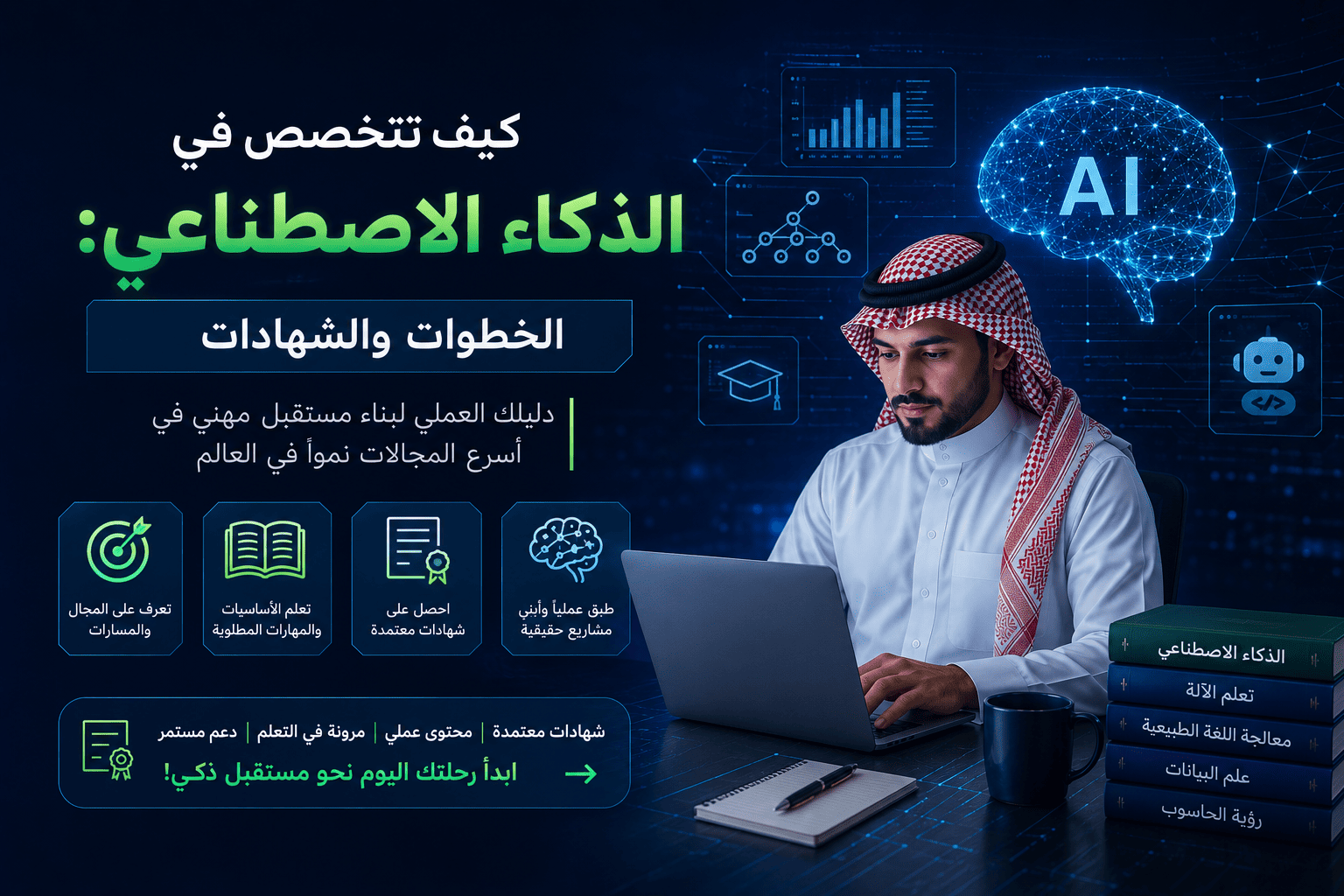
How to Specialize in Artificial Intelligence: Steps and Certifications
Artificial intelligence is no longer a field limited to researchers or major technology companies. It has become one of the fastest-growing and most influential specializations across various sectors, from healthcare and finance to education, industry, and e-commerce. In Saudi Arabia, interest in this field is growing significantly, driven by digital transformation projects and the objectives of Saudi Vision 2030, which places artificial intelligence among the key pillars for building a knowledge-based economy driven by innovation.
Despite this growth, many people who want to enter the field still face the same question: How do I start? Do I need a university degree? Do I have to be a programmer? What skills and certifications are employers looking for?
If you are looking for a clear roadmap, this guide explains the steps to specialize in artificial intelligence, the most important career paths, the certifications that can support your journey, and the job opportunities available in the Saudi market.
What Are the Specializations of Artificial Intelligence?
Artificial intelligence includes a wide range of fields, so it is important to understand each path before starting, so you can choose what aligns with your interests and career goals.
The most prominent specializations include:
Machine Learning
Machine learning is one of the most well-known branches of artificial intelligence. It depends on developing models that learn from data and predict outcomes without needing to be programmed directly for every case.
It is used in applications such as:
- Recommendation systems.
- Financial fraud detection.
- Sales forecasting.
- Customer behavior analysis.
Deep Learning
Deep learning relies on artificial neural networks to process complex data. It is used in applications that require a high level of accuracy, such as:
- Image recognition.
- Self-driving cars.
- Smart assistants.
- Machine translation.
Natural Language Processing
This field focuses on enabling systems to understand, analyze, and interact with human language.
Its most common applications include:
- Chatbots.
- Voice assistants.
- Instant translation.
- Sentiment analysis.
- Text summarization.
Computer Vision
Computer vision focuses on enabling computers to analyze images and videos and extract information from them.
It is used in:
- Security systems.
- Medical diagnosis.
- Facial recognition.
- Product quality inspection in factories.
Generative AI
Generative AI is one of the fastest-growing fields in recent years. It specializes in creating new content such as text, images, audio, and video using intelligent models.
Its use has become widespread in:
- Marketing.
- Customer service.
- Programming.
- Design.
- Content production.
AI Solutions Engineering
This path focuses on designing systems that rely on artificial intelligence technologies and integrating them with applications, databases, and infrastructure within organizations.
It is suitable for those who have a background in software development or systems engineering.
How Do You Choose the Right Path?
There is no single answer that suits everyone, but you can use your interests as a guide:
| If You Prefer... | This May Suit You... |
|---|---|
| Programming and algorithms | Machine learning |
| Mathematics and statistics | Data science and machine learning |
| Text analysis | Natural language processing |
| Images and videos | Computer vision |
| Content creation | Generative AI |
| Building systems | AI solutions engineering |
Choosing the right path from the beginning helps you focus on the required skills instead of trying to learn everything at once.
Accredited Certifications in Artificial Intelligence
Although practical skills and applied projects play an important role in employment, professional certifications add value to your CV, especially if you are at the beginning of your path or want to move into a new job.
The most prominent certifications and training programs in the field include:
Artificial Intelligence Fundamentals Certifications
These are suitable for beginners and focus on basic concepts, such as:
- Principles of artificial intelligence.
- Types of models.
- Uses of artificial intelligence in business.
- Ethical considerations.
Machine Learning Certifications
These focus on:
- Building models.
- Training algorithms.
- Evaluating performance.
- Improving prediction accuracy.
They are suitable for those who have a foundation in programming and mathematics.
Data Science Certifications
These combine data analysis, programming, and statistics, and prepare learners to work on transforming data into insights that help organizations make decisions.
Applied Artificial Intelligence Programs
Many training providers offer practical programs focused on using artificial intelligence tools in work environments, such as:
- Data analysis.
- Task automation.
- Improving productivity.
- Prompt engineering.
- Building solutions based on intelligent models.
These programs are a suitable option for employees and entrepreneurs who want to use artificial intelligence in their work without needing to pursue a full academic specialization.
What Skills Should You Acquire?
Regardless of the certification you choose, make sure to develop the following skills:
- Analytical thinking.
- Problem-solving.
- Programming fundamentals, especially Python.
- Working with data.
- Using modern artificial intelligence tools.
- Understanding the principles of machine learning.
- The ability to keep learning continuously.
These skills have become an essential element in most jobs related to artificial intelligence.
Job Opportunities in Artificial Intelligence in Saudi Arabia
The Saudi job market is witnessing rapid growth in demand for professionals specialized in artificial intelligence, driven by digital transformation projects and government and private investments in modern technologies. Saudi Vision 2030 has also contributed to accelerating the adoption of AI solutions across various sectors, leading to the emergence of new jobs and the expansion of technical and analytical roles.
Today, working in artificial intelligence is no longer limited to technology companies. The need for these skills now extends to sectors such as:
- Healthcare.
- Banks and financial services.
- E-commerce.
- Energy.
- Industry.
- Telecommunications.
- Government entities.
- Education.
- Logistics services.
The most prominent jobs in this field include:
AI Engineer
An AI Engineer is responsible for designing and developing solutions based on artificial intelligence technologies and integrating them with different systems within the organization.
Machine Learning Engineer
A Machine Learning Engineer focuses on building intelligent models, training them, and improving their performance using data.
Data Analyst
A Data Analyst collects and analyzes data to extract indicators that support decision-making, often using analysis tools and technologies based on artificial intelligence.
Data Scientist
A Data Scientist works on processing big data and building predictive models that help organizations improve performance and make more accurate decisions.
NLP Engineer
An NLP Engineer develops systems capable of understanding texts and human language, such as chatbots and intelligent search systems.
Computer Vision Engineer
A Computer Vision Engineer builds applications based on analyzing images and videos, such as facial recognition systems or product inspection systems in production lines.
AI Solutions Specialist
An AI Solutions Specialist helps organizations choose suitable technologies and apply them to improve operations and increase efficiency.
Average Salaries of Artificial Intelligence Specialists in Saudi Arabia
Salaries vary depending on experience, qualifications, company size, and the nature of the job role. However, artificial intelligence is considered one of the most competitive technical fields in terms of income level.
Approximate monthly salaries are as follows:
| Job Title | Average Monthly Salary |
|---|---|
| Data Analyst | SAR 8,000 – 15,000 |
| Machine Learning Engineer | SAR 15,000 – 25,000 |
| Data Scientist | SAR 18,000 – 30,000 |
| AI Engineer | SAR 18,000 – 35,000+ |
| AI Project Manager | SAR 25,000 – 40,000+ |
Note: These figures vary according to experience, sector, and required technical skills, and they may increase in international companies or specialized projects.
How to Start from Scratch
Some people believe that entering the field of artificial intelligence requires many years of study. In reality, many specialists started with simple steps and then gradually developed their skills.
If you do not have a technical background, you can follow this path:
1. Learn the Fundamentals of Artificial Intelligence
Start by understanding basic concepts, such as:
- What is artificial intelligence?
- How do intelligent models work?
- What is the difference between machine learning and deep learning?
- Where is artificial intelligence used?
This stage gives you a clear picture of the field before going deeper into it.
2. Develop Your Data Analysis Skills
Data is the foundation of most artificial intelligence applications, so it is useful to learn:
- Organizing data.
- Cleaning data.
- Analyzing data.
- Interpreting results.
3. Learn Programming Fundamentals
If you are targeting technical paths, it is better to learn Python, because it is the most widely used language in developing artificial intelligence applications and data analysis.
However, if your goal is to use artificial intelligence in your current work, you may be able to benefit from many modern tools without needing to go deeply into programming.
4. Use Artificial Intelligence Tools Practically
Practical application is one of the fastest ways to learn. Try using artificial intelligence tools in:
- Content writing.
- Data analysis.
- Preparing presentations.
- Automating repetitive tasks.
- Improving productivity.
Every project you complete will add to your practical experience.
5. Commit to Continuous Learning
The field of artificial intelligence is developing very quickly. Therefore, keeping up with updates, experimenting with new tools, and continuously updating your skills are essential parts of success in this field.
Read Also
Frequently Asked Questions
What Are the Specializations of Artificial Intelligence?
The field includes many specializations, such as machine learning, deep learning, computer vision, natural language processing, data science, and AI solutions engineering. Each path differs in the nature of work and the skills required.
How Can I Specialize in Artificial Intelligence Without a Technical Background?
You can start by understanding the fundamentals of artificial intelligence, then learn data analysis and use intelligent tools in practical applications. If you want to work in technical roles, you will later need to learn programming fundamentals, especially Python.
What Is the Best Certification in Artificial Intelligence?
This depends on your level and career goals. Beginners can start with foundational programs, while specialized certifications are suitable for those who have experience and want to go deeper into fields such as machine learning or data science.
How Much Does an Artificial Intelligence Specialist Earn?
Salaries vary depending on experience, job role, and sector. However, artificial intelligence is considered one of the high-paying fields in the Saudi market, especially for specialists who combine technical skills with practical experience.
Does Artificial Intelligence Require a Programming Background?
Not always. Some jobs depend on using artificial intelligence tools, project management, or business analysis, and do not require advanced programming experience. However, developing models and building intelligent applications requires knowledge of programming and data analysis.
Develop Your Professional Future with IGTS
If you want to enter the field of artificial intelligence or develop your skills to keep up with digital transformation, having a practical foundation in artificial intelligence technologies has become one of the most important factors of distinction in the Saudi job market, as companies increasingly rely on intelligent solutions across various sectors.
Start your journey with IGTS Artificial Intelligence Programs and Courses, and benefit from practical training content that helps you understand the fundamental concepts, explore the latest applications, and acquire the skills that qualify you to build a strong career path in this evolving field.
Start Now
Develop your skills in artificial intelligence and modern technologies through IGTS training programs and courses, and choose the program that matches your level and professional goals.
Updated at: 2026-10-10 17:56:48