
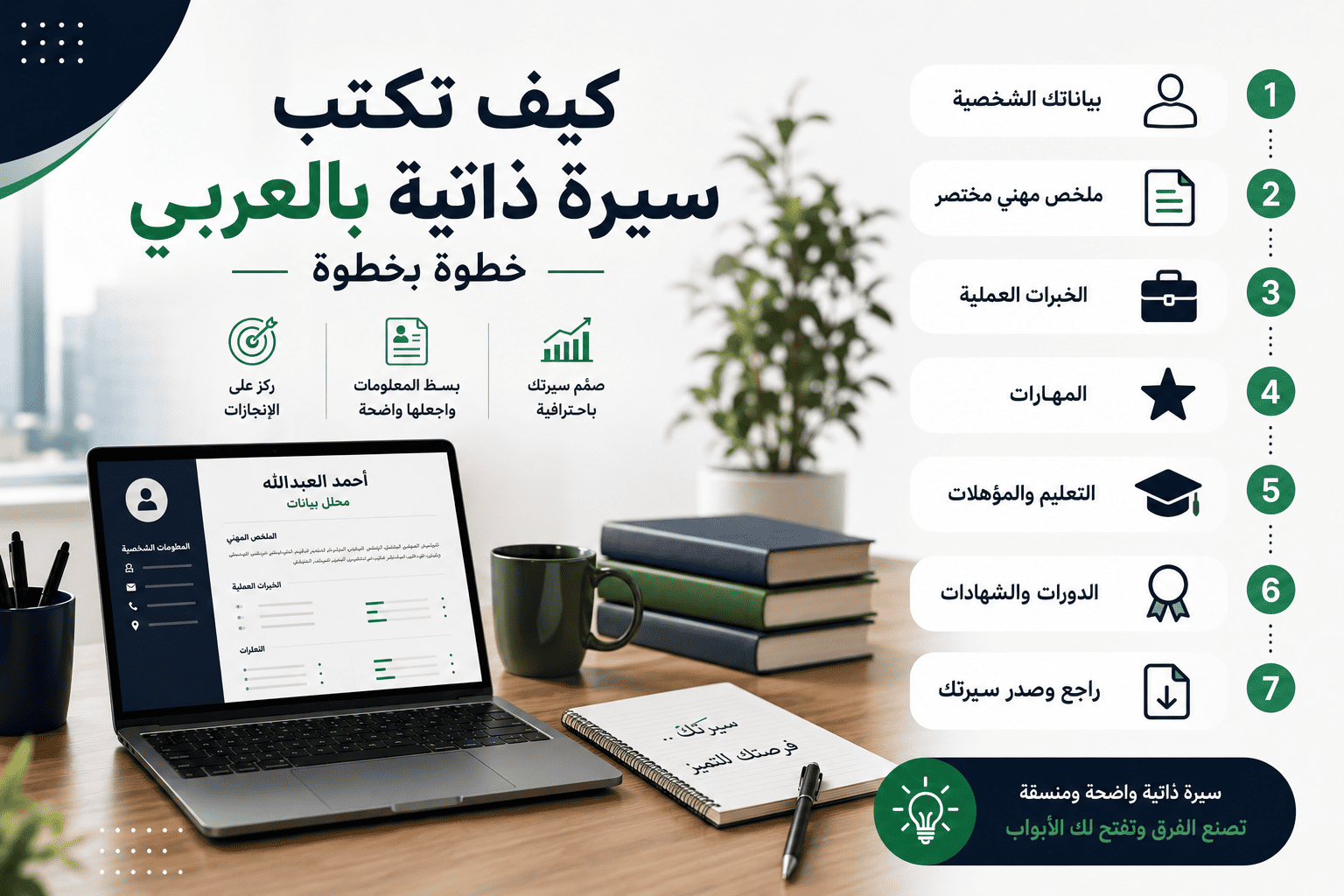
How to Write a CV in Arabic Step by Step
If you are wondering how to create a CV that helps you apply for jobs with confidence, you are not alone. Many graduates and job seekers struggle to know where to start when writing a CV, what information should be added, and how to organize it professionally.
Writing a CV is one of the most important steps when looking for a job, because it gives the recruiter the first impression of your qualifications, experience, and skills. Therefore, organizing the information and choosing the right content is just as important as the experience itself.
In this guide, you will learn how to prepare a CV in Arabic step by step, starting from basic information, through the career objective, experience, qualifications, and skills, all the way to a CV template that you can use when preparing your own CV.
What Are the Sections of a Professional CV?
Before you start writing any information, it is important to know the general structure of a CV. Having a clear order for the sections helps the recruiter access information quickly and makes your CV look more professional.
In most jobs inside Saudi Arabia, a CV consists of the following sections:
- Personal information.
- Career objective.
- Work experience.
- Educational qualifications.
- Skills.
It is preferable to arrange these sections logically, so that the most important information appears first, while maintaining consistent formatting, a clear font, and suitable spacing between each section.
There is no need to add information that does not serve the job you are applying for. A successful CV depends on the clarity of information more than the amount of detail.
Step 1: Personal Information
Start by writing the basic information that helps the employer identify you and contact you easily.
Usually, it is enough to include the following details:
- Full name.
- Phone number.
- Professional email address.
- City or place of residence.
- LinkedIn profile link, if it is updated.
Make sure your email address is professional, preferably including your real name, and avoid using informal names that may give an unsuitable impression.
It is also better to use one phone number that you can be easily reached through, and to make sure all contact details are correct before sending the CV.
Example:
Name: Ahmed Mohammed Al-Otaibi
Phone number: 05XXXXXXXX
Email: ahmed@email.com
City: Riyadh
LinkedIn: linkedin.com/in/ahmed
It is not recommended to add information that is not related to employment, such as hobbies that are unrelated to the job or personal details that the employer did not request.
Step 2: Career Objective
After personal information comes the career objective, which is a short paragraph that explains the type of job you are seeking and what you can offer the employer.
This section does not need a long introduction. It is enough to explain your experience or qualification, the job you are targeting, and the value you can add.
Example for a recent graduate:
Business Administration graduate seeking to start my professional career in a work environment that helps me develop my skills and contribute to achieving the organization’s goals through continuous learning and taking responsibility.
Example for someone with experience:
Human Resources Specialist with five years of experience in recruitment and performance management, seeking to join a team where I can contribute to developing processes and improving the employee experience.
Make sure to customize the career objective according to the job you are applying for, instead of using one text for all job applications.
Step 3: Work Experience
If you have work experience, this section will often be the first thing the recruiter looks for. Therefore, do not simply mention company names or job titles. Explain what you were responsible for and what achievements you accomplished during your work period.
Start with your most recent job, then move to previous jobs in reverse chronological order. For each job, make sure to clarify:
- Job title.
- Company name.
- Employment period.
- Key responsibilities or achievements.
Instead of writing a long list of daily tasks, focus on the work that reflects your experience and shows the value you added in the workplace.
Example:
Human Resources Specialist
XYZ Company
January 2022 to March 2025
Coordinated recruitment processes from receiving applications to completing hiring procedures.
Followed up on employee files and updated their data.
Contributed to organizing internal training programs.
Prepared periodic reports to support management decisions.
If you are a recent graduate and have never worked full-time, do not leave this section empty. You can add cooperative training, summer training, volunteer work, or university projects if they are related to the job you are applying for.
Step 4: Educational Qualifications
After work experience, move on to your educational qualifications, arranged from the most recent to the oldest.
Usually, it is enough to include the following information:
- Name of the qualification.
- Name of the university or educational institution.
- Year of graduation or expected graduation year.
Example:
Bachelor’s Degree in Business Administration
King Saud University
2024
If you are a recent graduate, you can add your graduation project or any academic achievement related to the target job, especially if you do not yet have work experience.
However, if you have several years of professional experience, it is better to keep this section limited to basic information, because employers usually give more importance to practical experience at this stage.
Step 5: Skills
This section gives the recruiter a quick idea of the skills you have. Therefore, make sure to choose skills that are related to the job instead of adding a long list that does not serve your goal.
You can combine technical skills and soft skills, while focusing on what you can actually apply in the work environment.
Examples of skills:
- Effective communication.
- Teamwork.
- Time management.
- Problem-solving.
- Using Microsoft Office.
- Report preparation.
- File management.
- Customer service.
If you have professional certifications or training courses related to your field, it is appropriate to add them after the skills section, because they support your qualifications and reflect your interest in continuous development.
Before sending your CV, review the skills again and remove any skill that you cannot prove during the job interview. Credibility remains more important than the number of skills listed.
Arabic CV Template
After learning about the basic sections, you can use the following sample template as a starting point when preparing your CV. Make sure to edit all details according to your qualifications and experience, and do not forget to customize your CV for each job you apply for.
The template is as follows:
Mohammed Khaled Al-Otaibi
Riyadh, Kingdom of Saudi Arabia
05XXXXXXXX
m.otaibi@email.com
linkedin.com/in/mohammedotaibi
Career Objective
Business Administration graduate seeking to start my professional career in the field of human resources. I aim to join a work environment that enables me to develop my skills and contribute to achieving the organization’s goals.
Work Experience
Human Resources Intern
ABC Company
June 2024 – August 2024
- Assisted in coordinating recruitment processes.
- Updated employee data in the system.
- Organized human resources files.
- Prepared weekly reports for management.
Educational Qualifications
Bachelor’s Degree in Business Administration
King Saud University
2024
Skills
- Effective communication.
- Teamwork.
- Time management.
- Microsoft Office.
- Report preparation.
After finishing writing your information, review your CV before sending it, and make sure all information is correct, the formatting is consistent, and the content is free from spelling or language errors.
It is also preferable to save the CV in PDF format before sending it, so the formatting appears the same when the file is opened on any device.
If you want to improve the design of your CV, you can read the article “Attractive CV Design.”
If you are looking for a way to save or create it in PDF format, you can refer to the article “Create a CV in PDF for Free.”
Read Also
Frequently Asked Questions
How Do I Write a CV in Arabic for the First Time?
If this is your first time writing a CV, start with personal information, then add a suitable career objective. After that, write your educational qualifications and work experience, if available, then list the skills related to the job. If you do not have work experience, you can add training, volunteer work, or relevant academic projects.
What Is the Ideal Length for a CV?
It is preferable for the CV to be concise and clear. One page is usually enough for graduates and recent graduates, while it may extend to two pages when there are multiple work experiences, while avoiding information that does not serve the job.
Should I Write My CV in Arabic or English in Saudi Arabia?
This depends on the language of the job advertisement. If the advertisement is in Arabic, it is appropriate to use a CV in Arabic. If the advertisement is in English, it is better to send the English version, unless the employer specifies a different language.
What Is the Difference Between a CV and a Resume?
A CV usually refers to a document that includes more details about qualifications and experience, while a resume is more concise and focuses on information directly related to the target job. The use of the two terms differs depending on the country and employer.
How Do I Highlight My Skills in a CV?
Choose the skills that match the job requirements, and avoid adding general skills that you cannot prove. Whenever possible, connect your skills to your work experience or previous achievements, because this gives them greater credibility.
Conclusion
If you are wondering how to create a CV professionally, the starting point is organizing the information before writing it. Make sure to include the basic sections: personal information, career objective, work experience, educational qualifications, and skills, arranged clearly and in a way that is easy to read.
Remember that writing a CV is not just about filling in data. It is an opportunity to present your qualifications and experience in a way that helps the recruiter understand what you can offer to the job. Therefore, customize your CV for every opportunity you apply for, and review it carefully before sending to ensure the accuracy of the information, the quality of the language, and the consistency of the formatting.
Develop Your Skills
Having a professional CV is the first step, but developing your skills is what helps you strengthen your opportunities in the job market.
Develop your skills and register for the accredited IGTS Diploma.
Start Now
Build your personal brand and strengthen your professional presence on LinkedIn using artificial intelligence.
Updated at: 2026-10-10 15:28:50