
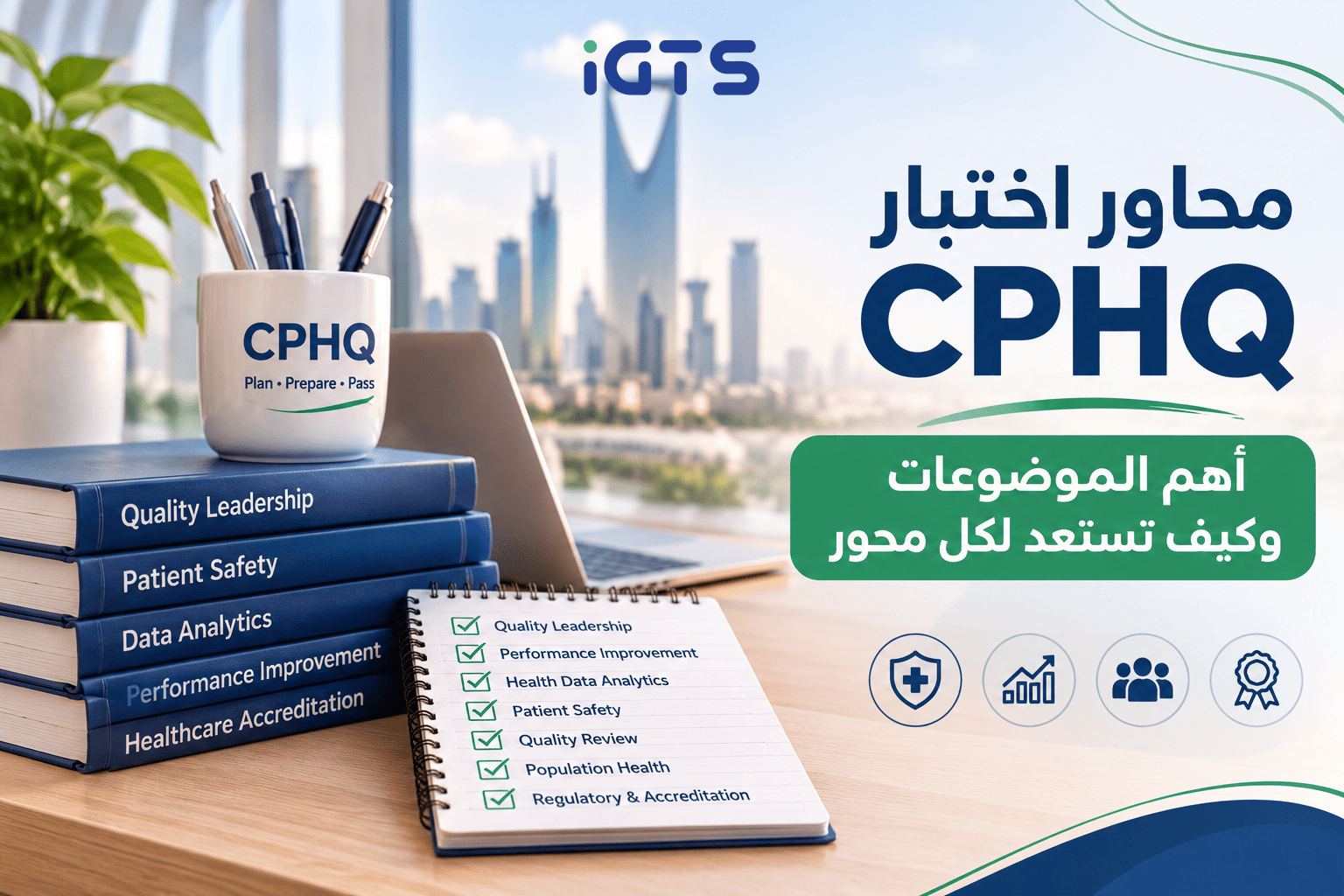
CPHQ Exam Domains: Key Topics and How to Prepare for Each Domain
If you are preparing for the CPHQ exam, understanding the CPHQ exam domains is the first step toward organizing your study plan and identifying the topics that deserve the most attention. The exam consists of seven domains covering healthcare quality, performance improvement, data analytics, patient safety, leadership, accreditation, and other tasks related to healthcare quality practice.
The exam does not rely on memorizing definitions alone. It also measures your ability to understand concepts, apply them, and analyze work-related situations. For that reason, it is important to understand the content of each domain, identify the topics that require more review, and practice questions that involve decision-making or data interpretation.
In this guide, you will learn about the CPHQ content outline, the main topics covered in each domain, how to prepare for application-based questions, and answers to common questions about the exam.
What Is the CPHQ Exam and How Is Its Content Organized?
CPHQ stands for Certified Professional in Healthcare Quality. It is a professional certification exam that measures a candidate's knowledge and skills related to quality management, performance improvement, and patient safety in healthcare organizations.
The CPHQ credential is awarded through the Healthcare Quality Certification Commission (HQCC), the certification body associated with NAHQ, the National Association for Healthcare Quality.
The exam content is based on an analysis of professional tasks performed by healthcare quality professionals, which means the questions are connected to the skills required in hospitals, clinics, and other healthcare settings.
What Are the CPHQ Exam Domains?
The CPHQ exam consists of seven main domains covering quality leadership, performance and process improvement, health data analytics, patient safety, quality review and accountability, regulatory and accreditation requirements, and population health and care transitions.
Understanding these domains helps you identify the topics you need to study, understand the skills assessed by the exam, and allocate your study time according to your current knowledge and professional experience.
How Does the Exam Assess Your Knowledge?
The CPHQ exam is not limited to recalling information. It also includes questions that require you to apply concepts to professional situations and analyze information in order to choose the most appropriate response.
According to the official content outline, the scored questions are distributed approximately as follows:
- 23% require recall of information.
- 57% require application of knowledge.
- 20% require analysis.
This means that effective preparation requires understanding concepts and practicing how to use them in healthcare quality situations rather than relying on memorization alone.
Read Also
What Are the CPHQ Exam Domains in the Official Content Outline?
The content outline includes seven domains with a total of 125 scored questions. The following table ranks them by number of scored questions and summarizes the main topics and practical skill assessed in each domain.
| Domain | Scored Questions | Main Topics | Application Skill |
|---|---|---|---|
| Performance and Process Improvement | 27 | PDSA cycle, Lean, Six Sigma, quality tools, and change leadership | Selecting the appropriate tool or methodology for a specific problem |
| Health Data Analytics | 26 | Indicator design, descriptive statistics, control charts, and dashboards | Interpreting a chart or indicator and choosing the appropriate action |
| Quality Leadership and Integration | 19 | Strategic planning, quality culture, and stakeholder engagement | Connecting a quality initiative with organizational goals |
| Patient Safety | 18 | Root cause analysis (RCA), sentinel events, failure mode and effects analysis (FMEA), and safety culture | Choosing the most appropriate response after an incident or safety report |
| Quality Review and Accountability | 16 | Performance review, compliance, and quality-linked payment programs | Identifying the appropriate action in a review or accountability situation |
| Population Health and Care Transitions | 11 | Determinants of health, care coordination, and transition gaps between organizations | Designing an intervention for a patient population or transition-of-care situation |
| Regulatory and Accreditation | 8 | Accreditation readiness and regulatory requirements | Connecting a standard with everyday practice |
The question counts above are based on the published NAHQ content outline. Review the current version before relying on them because the outline may be updated.
The Two Largest Domains: Performance Improvement and Data Analytics
Together, these two domains account for 53 of the 125 scored questions, so they deserve significant attention early in your preparation. In Performance and Process Improvement, it is not enough to memorize the steps of PDSA or the definition of Lean. The key is to understand when each tool should be used. Some tools help identify causes of a problem, some help measure the effect of a change, and others help structure team activities.
In Health Data Analytics, practice reading control charts, distinguishing common variation from changes that may require intervention, and differentiating outcome measures from process measures. Expect questions that ask you to interpret a number or chart before selecting an action.
Leadership, Safety, and Review Domains
Quality Leadership and Integration, Patient Safety, and Quality Review and Accountability also account for a large portion of the scored questions. Their questions often involve organizational scenarios, so ask yourself: what is the most logical next step?
In patient safety, the sequence of actions after an event matters, from immediate containment to analysis and follow-up. In leadership, connecting quality initiatives with strategy and management support is important. In quality review and accountability, distinguish between actions intended primarily for compliance and those aimed at improvement.
The Smaller Domains: Population Health and Regulatory/Accreditation
Population Health and Care Transitions and Regulatory and Accreditation together account for 19 scored questions. This does not mean they should be ignored. They may become relatively efficient areas to improve if you study their concepts consistently.
Start with the topics listed in the official outline, then compare them with accreditation standards or regulatory practices you already know in your own healthcare environment to understand similarities and differences.
How Should You Approach Application-Based Questions in Each CPHQ Domain?
Understanding the CPHQ exam domains is important, but effective preparation also requires learning how to use the information in realistic healthcare quality situations.
You can follow these steps:
1. Understand the Concept Before Memorizing the Definition
Begin by identifying what the concept means, why it is used, and what type of problem it helps solve.
For example, when reviewing performance improvement tools, do not simply memorize the name of each tool. Understand when it should be used, what information it requires, and how it supports problem analysis.
2. Connect Each Topic to a Practical Situation
Try to turn every concept into an example from a healthcare environment.
If you are reviewing data analytics, think about how indicators could be used to monitor the performance of a hospital department.
If you are reviewing patient safety, think about how you would analyze a safety event or identify potential risks before an event occurs.
3. Practice Interpreting the Question
Before choosing an answer, identify:
- What is the main problem in the question?
- What information do you need to use?
- Are you being asked to identify a cause, evaluate data, or choose an action?
- Which answer best matches the concept being tested?
This approach helps you understand what the question is actually asking instead of depending only on keywords.
4. Review Why the Correct Answer Is Correct
After answering a question, do not stop at identifying the correct option.
Review why it is correct and understand why the other options are less appropriate for the situation.
If you answer incorrectly, record the topic that needs further review and return to the appropriate reference before moving on to more questions.
5. Allocate Your Time According to Your Needs
You do not need to divide your study time equally across all seven domains.
Start by reviewing the official content outline, then identify which domains need more time based on your experience and your practice-question results.
You can use the following table to evaluate your preparation:
| Domain | Your Understanding | What You Need to Review |
|---|---|---|
| Quality Leadership and Integration | Good / Moderate / Needs Review | Planning and governance |
| Performance and Process Improvement | Good / Moderate / Needs Review | Improvement tools |
| Health Data Analytics | Good / Moderate / Needs Review | Statistics and data interpretation |
| Population Health and Care Transitions | Good / Moderate / Needs Review | Coordination and continuity of care |
| Patient Safety | Good / Moderate / Needs Review | Event and risk analysis |
| Quality Review and Accountability | Good / Moderate / Needs Review | Standards and documentation |
| Regulatory and Accreditation | Good / Moderate / Needs Review | Compliance and accreditation readiness |
Use this table to identify your review priorities rather than treating it as an official readiness assessment.
Frequently Asked Questions About CPHQ Exam Domains
How Many Domains Are on the CPHQ Exam?
The CPHQ exam consists of seven main domains: Quality Leadership and Integration, Performance and Process Improvement, Health Data Analytics, Population Health and Care Transitions, Patient Safety, Quality Review and Accountability, and Regulatory and Accreditation.
Are CPHQ Exam Questions Application-Based or Theoretical?
The exam includes questions that require recall, application of knowledge, and analysis of professional situations. According to the official content outline, application and analysis questions make up the majority of the scored questions, so it is important to understand the concepts and practice using them in realistic situations.
Where Can I Find the Official CPHQ Exam Content Outline?
You can review the exam content outline and candidate handbook through the official National Association for Healthcare Quality (NAHQ) resources. It is best to review the latest version before starting your study plan so that you understand the domains and topics covered by the current exam.
Does the CPHQ Exam Include Data Analysis?
Yes. The exam includes a dedicated Health Data Analytics domain covering the design, management, measurement, and analysis of data. Some questions also require candidates to use information and data to understand performance or identify opportunities for improvement.
Start Preparing for the CPHQ Exam With a Clear Plan
Understanding the CPHQ exam domains helps you understand the exam content and identify the topics that need more review. However, preparation should not stop at reading the domains. You also need to understand the concepts, practice application-based questions, review your mistakes, and measure your progress consistently.
Start with the official content outline, then identify your strengths and the topics you need to develop, and allocate your time according to your current knowledge and healthcare quality experience.
If you are looking for a structured way to review the exam domains, explore the CPHQ preparation program at IGTS and review the program details and content to determine whether it matches your professional learning needs.
Start Preparing for the CPHQ Exam
Explore the CPHQ preparation program at IGTS and review its training content, or contact us to learn more about the program.
CPHQ Preparation Program Contact Us on WhatsAppUpdated at: 2026-11-04 14:28:42